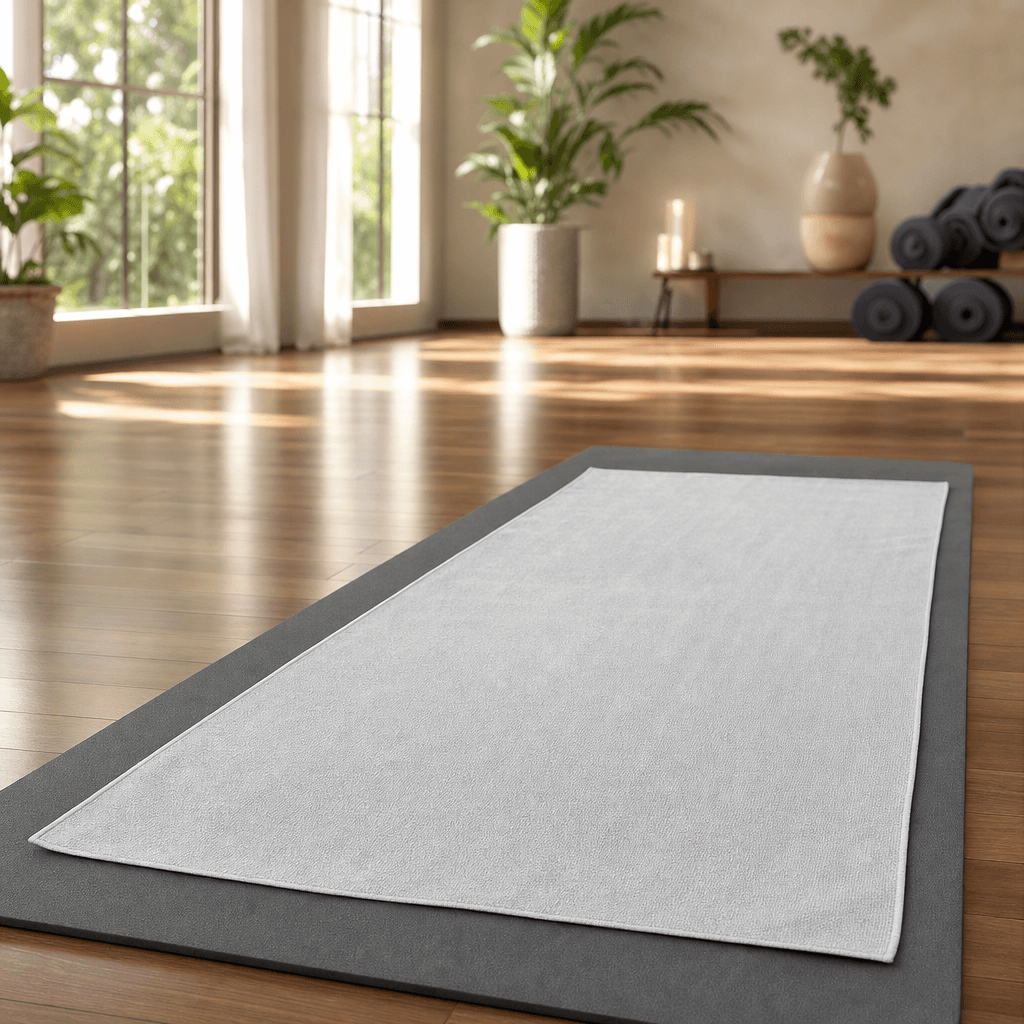

Yoga Towels Wholesale: A Bulk Buyer's Guide for Studios & Spas
A yoga towel looks like a small purchase until you count how many a busy studio, hotel gym, or spa goes through in a month. Buy the wrong spec and you will reorder the whole stock within a season. Here is what we tell buyers who call us about yoga towels.
Match towel weight to your climate and class type, pick fabric based on your laundry process, budget around volume tiers rather than list price, test samples hard before ordering, and wash them gently enough to reach 200+ cycles.
What GSM range should hotels, gyms, and spas look for when buying yoga towels in bulk, and how does weight affect absorbency and drying time?
It depends on the material, because the industry measures two families of towel differently. Microfiber yoga towels are one of the few places where GSM is the right yardstick. Lightweight microfiber mat towels sit around 240 to 320 GSM, while a plush 900 GSM microfiber is a body-drying towel and is too bulky to lay over a mat. For a grip towel that sits on top of a mat in a hot class, the thinner 240 to 320 GSM range dries fast and folds small enough for a locker.
Cotton terry is a different conversation. We do not quote GSM for it. We quote size and pounds per dozen. An economy 20x40 runs about 4 lbs/dz. A premium 24x50 runs about 10 lbs/dz. That is more than double the cotton in each towel, and you feel it in the hand and in the dryer. A 4 lbs/dz towel dries quickly but wrings out fast during a sweaty class. A 10 lbs/dz towel soaks up far more, and that is exactly what a spa wants after a treatment. It also means longer dryer cycles and higher utility bills when you are turning over a few hundred towels a day.
The practical rule is simple. Hot yoga and high-turnover studios should lean light, because drying time is the bottleneck. Spas and hotel wellness rooms should lean heavy, because guests judge quality by weight. If you are stocking a gym with mixed use, many buyers split the order, with lighter towels for class and heavier bath-size towels for the shower area. For the heavier end, our bulk towels range is the place to compare sizes up to 27x54 and bath sheets at 30x60.
Microfiber, cotton, or a blend: which yoga towel fabric holds up best to daily commercial use and repeated industrial laundering?
We get the terry cloth vs microfiber question more than almost any other. The honest answer is that each wins in a different job. Microfiber wins on grip, since it clings to a mat when damp, and it dries quickly. It loses on heat. Put it through a high-temperature dryer with fabric softener residue and the fibers can mat down and stop absorbing. Softener is the number one killer of microfiber we see in customer returns.
Cotton terry wins on durability and on laundry tolerance. A 100% cotton towel can take bleach, hot water, and hard commercial machines, which is why white cotton remains the top choice for hotels and salons. White also shows cleanliness at a glance, and you can bleach it back to bright. Black is growing among salons and studios that want to hide dye and product stains, though it will not take bleach. Our commercial-grade cotton is built for 200+ wash cycles. The same towel bought at retail typically gives out between 50 and 100.
Blends sit in the middle. For economy and motel-grade programs we supply 86% cotton, 14% polyester, which resists shrinkage and costs less per piece. The tradeoff is a slightly less plush feel and lower absorbency than pure cotton. If your priority is a long-lasting, low-cost towel for a gym floor, a blend is sensible. If you run a spa and want guests to notice quality, stay with 100% cotton. For a hand-size sweat towel at the front desk or on cardio equipment, our wholesale hand towels at 16x27 are the common pick.
How much should a wholesale buyer expect to pay per unit for yoga towels at 100, 500, and 1,000+ piece order volumes, and where do the real cost savings come from?
Per-unit price moves with weight, fiber, size, and whether the towel is embroidered, so any single number would mislead you. What I can give you is how the structure works. Our published tier pricing takes 5% off at 5 units, 10% off at 10 units, and 15% off at 15 or more units. Those tiers are transparent so you can see the effect on your quote before you commit. At 100 pieces you are already in the top discount band. At 500 and 1,000 or more, you are negotiating freight and production scheduling on top of that, which is where a family-owned supplier can be flexible and a marketplace cannot.
The discount is the smaller part of the savings. The real money is in replacement cycle. The most common mistake we see is a buyer purchasing consumer-grade towels for commercial use because the sticker price is lower. Those towels get replaced every 3 to 6 months. A commercial-grade towel lasts 2 to 3 years. Run the math on a 500-piece studio inventory and the cheaper towel costs you four to six full restocks for every one of ours, plus the labor of unpacking, tagging, and retiring the old stock.
Other savings are smaller but real. Ordering one size and one color across locations simplifies reorders and keeps your par levels simple. Stock towels ship in 2 to 3 business days, while custom or embroidered orders take 7 to 10 days, so plan logo work ahead of a seasonal opening rather than paying for rush handling. If you are buying wholesale beach towels for a resort pool alongside yoga towels, combining them in one order puts both lines at the higher tier. Buying towels in bulk from one source also means one set of specs to inspect.
What quality checks should purchasing managers run on yoga towel samples before placing a bulk order, from stitching and edge finishing to grip and colorfastness?
Start with the edges. Turn the towel over and look at the hem. A good commercial hem has tight, even stitching with no skipped stitches, and the thread ends are locked in. Pull gently at a corner. If a seam gives or the pile pulls out along the edge, that towel will fray before its tenth wash. Check dimensions with a tape measure too. A towel sold as 24x50 that measures 23x48 before washing will shrink further, and you will be left short of mat coverage.
Next, wash the sample. Do not just inspect it out of the bag. Run it through five cycles at the temperature your laundry actually uses, then measure again. Cotton shrinkage of a few percent is normal. Much more than that tells you the yarn was not pre-shrunk. For colorfastness, wash a dark or colored sample with a white towel in the same load. Any dye on the white towel is a fail. If you buy black or a bold studio color, this one test saves you a lot of ruined whites.
Finally, test the job it is meant to do. For microfiber, lay it on a mat, dampen both, and do a downward dog. It should hold. Pour a measured cup of water on a cotton sample and see how long it takes to absorb. A towel that beads the water is carrying finish residue, which should wash out in the first few cycles. If it does not, ask the supplier why. Ask for samples of two different weights side by side. The difference between 4 and 10 lbs/dz is obvious in your hand, and it helps your team agree on a spec before you spend on volume. Any supplier who sells wholesale towels to commercial accounts should be glad to send them.
How should facilities wash and maintain yoga towels to extend their service life, and how many laundry cycles can a commercial-grade towel realistically withstand?
Commercial-grade cotton towels are built for 200+ wash cycles. Consumer retail towels usually fail at 50 to 100. Reaching that 200 mark depends on the laundry room as much as the towel. The biggest wear factors are overloading the machine, using too much detergent, and over-drying. A load packed tight does not rinse properly, and detergent left in the pile makes towels stiff and less absorbent. Fill machines to about three quarters of capacity and use the dose your chemical supplier specifies, not a bit extra to be safe.
Skip fabric softener on every yoga towel, and especially on microfiber. Softener coats the fibers and kills both absorbency and grip. White cotton can handle chlorine bleach at the proper dilution, though overuse weakens the fiber over time, so bleach on a schedule rather than every load. Black and colored towels should be washed separately in cooler water with a color-safe oxygen-based product. Dry at medium heat and pull them while slightly damp. Over-drying makes cotton brittle, and microfiber can melt at high heat. For guidance on laundering standards, the Textile Rental Services Association publishes practical resources for commercial laundry operations.
Rotate your stock. If you keep one stack on top that gets pulled first, those towels hit 200 washes while the bottom stack sits fresh. Number your par levels so that every towel gets the same turn. Retire towels at visible warning signs: thinning pile, curled hems, persistent odor after washing, or stains that no longer lift. A towel in that state is a hygiene issue for your guests, not just an appearance issue. Spa operators who source spa towels wholesale and rotate properly usually run the same stock for two to three years.
Frequently Asked Questions
- What GSM range should hotels, gyms, and spas look for when buying yoga towels in bulk, and how does weight affect absorbency and drying time?
- For microfiber, 240 to 320 GSM suits mat-top use, while 900 GSM is a plush body-drying towel. For cotton we use lbs/dz instead, from about 4 lbs/dz for an economy 20x40 to about 10 lbs/dz for a premium 24x50. Heavier towels absorb more but take longer to dry.
- Microfiber, cotton, or a blend: which yoga towel fabric holds up best to daily commercial use and repeated industrial laundering?
- 100% cotton handles bleach and hard commercial washing best and is built for 200+ cycles. Microfiber grips a mat better but suffers from softener and high heat. An 86% cotton, 14% polyester blend is a good low-cost option for gyms.
- How much should a wholesale buyer expect to pay per unit for yoga towels at 100, 500, and 1,000+ piece order volumes, and where do the real cost savings come from?
- Price depends on weight, size, and fiber, and tier discounts run 5% at 5 units, 10% at 10 units, and 15% at 15 or more. The larger saving is the replacement cycle. Commercial-grade towels last 2 to 3 years against 3 to 6 months for consumer-grade.
- What quality checks should purchasing managers run on yoga towel samples before placing a bulk order, from stitching and edge finishing to grip and colorfastness?
- Inspect the hem stitching, pull-test the corners, and measure before and after five wash cycles. Wash dark samples with a white towel to check for dye transfer. Test grip on a damp mat and absorbency with a measured pour of water.
- How should facilities wash and maintain yoga towels to extend their service life, and how many laundry cycles can a commercial-grade towel realistically withstand?
- A commercial-grade towel can withstand 200+ wash cycles, compared with 50 to 100 for retail towels. Avoid overloading, skip fabric softener, dry on medium heat, and rotate stock evenly. Retire any towel with thinning pile or lingering odor.

