
Wholesale Washcloths: Buyer's Guide for Hotels, Spas, Salons
The washcloth is the smallest item on your purchase order and the one that disappears fastest. It gets bleached, bound up in sheets, and carried out in luggage. Buy the wrong one and you are reordering twice a year, so the details matter more than the size suggests.
Buy 12x12 washcloths by weight in lbs/dz rather than GSM, check hems and shrinkage before you commit, compare quotes by price per pound, choose 100% cotton for bleach and heat, and stock three to four times your daily usage.
What GSM range should hotels, spas, and salons look for when ordering washcloths in bulk?
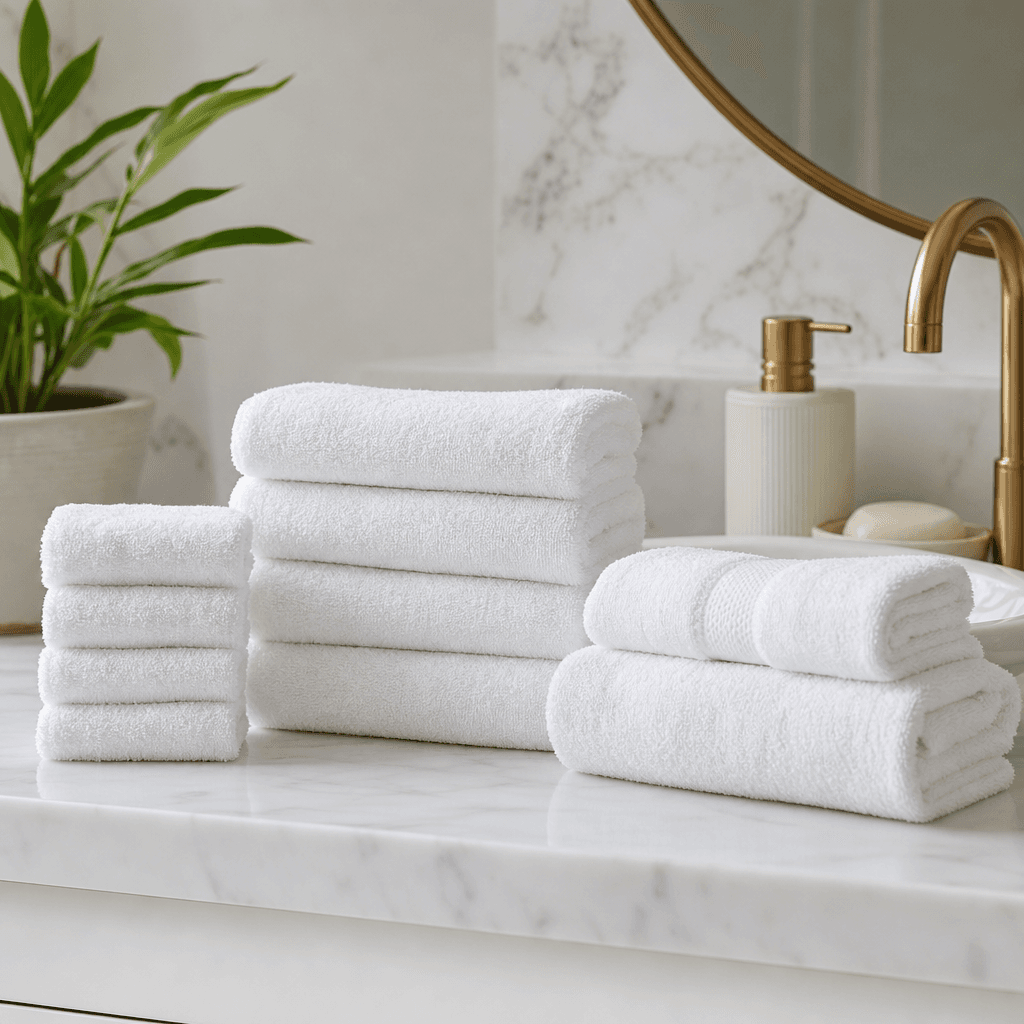
Short answer: none. We do not spec standard terry by GSM, and you should be wary of a supplier who leads with it. Commercial terry is sold by size and weight per dozen, written as lbs/dz. A standard wash cloth is 12x12. To give you a sense of how weight works across the line, an economy 20x40 bath towel runs 4 lbs/dz and a premium 24x50 runs 10 lbs/dz. Washcloths follow the same logic. A heavier dozen holds more cotton yarn and more loop, and that shows up in absorbency and life. GSM belongs to specialty items, like 900 GSM microfiber or a few specific 240 and 320 GSM products.
So match the weight to the job. Hotels doing guest bath service usually want a mid to premium weight, because guests judge a washcloth by hand feel in the first five seconds. Motels and budget properties often do well with an 86% cotton, 14% polyester economy blend, which dries faster and costs less per dozen. Spas buying spa towels wholesale tend to go heavier, since hot towel service and body treatments need a cloth that holds heat and water. Salons shopping for wholesale salon towels mostly choose white, because you can bleach it hard and it shows the client the linen is clean. Black is growing fast in color-service salons because it hides dye stains.
Heavier is not always better. A heavier cloth takes longer to dry, which adds dryer minutes on every load. If you ask which are the best washcloths for body use, spa buyers usually want a dense, even loop that scrubs gently and still wrings out by hand. Ask for a sample dozen, put it on a scale, and compare the number to the weight on the spec sheet. Our wholesale washcloths list lbs/dz so you can check that yourself.
How do you tell a high-quality wholesale washcloth from one that will fall apart after 50 commercial washes?
Start with the hem. Pick up the cloth and look at the stitching on all four edges. You want a tight, even stitch with no skipped sections, and the hem should lie flat instead of rolling. Most washcloths die at the edge. Once a hem opens, the cloth frays through the pile within a few cycles. Then pull the loops gently with a fingernail. Loops that lift easily will snag in the dryer and shed lint into every load afterward.
The best test costs you one sample dozen and a week. Run it through your own laundry ten times, hot water, your normal bleach and detergent, your normal dryer. Measure it afterward. A 12x12 cloth that comes out visibly smaller or twisted into a diamond shape will not survive long. Check for thinning where you can see light through the pile. Our commercial-grade goods are built for 200+ wash cycles, while consumer retail towels commonly give out at 50 to 100. That gap is the whole difference between linen and a disposable item.
The mistake we see most often is a buyer picking up consumer-grade towels at a big box store for commercial use. Those get replaced every 3 to 6 months. Commercial grade lasts 2 to 3 years in the same service. If you have ever asked how often you should replace washcloths, here is the practical answer: when hems open, when the cloth stops absorbing, or when stains stay after a normal bleach cycle. The same construction standard applies to our wholesale hand towels, so you can judge both by the same checks.
What does a fair per-dozen price for wholesale washcloths look like, and when do bulk discounts actually save money?
A fair price tracks weight. Two dozens can both be 12x12 and 100% cotton, yet one is far heavier than the other. The easiest way to compare quotes is price per pound. Take the per-dozen price and divide it by the lbs/dz. If one supplier looks cheap, check whether the cloth is simply lighter. A thin dozen at a low price is often a more expensive cloth per pound of cotton, and it wears out faster. Blends at 86% cotton and 14% polyester will price below 100% cotton, and that is fair, as long as you are buying them for the right use.
Cost per wash tells the real story. Say a dozen costs twice as much but lasts 200 cycles instead of 50. You are paying half as much per use, and you are also buying, receiving, and stocking replacements a quarter as often. A buyer who replaces consumer towels every few months is not saving anything. They are paying a hidden subscription.
Volume pricing helps when you buy enough to reach the next tier. Ours is transparent: 5% off at 5 units, 10% at 10 units, and 15% at 15 or more. B2B buyers usually place orders of 100 to 500+ units, so most of our customers land in the top tier without trying. The discount stops saving money when you overbuy beyond what you can store or rotate. Buying two full par sets at the 15% tier is smart. Buying five sets for a 40-room property just ties up cash and closet space. Standard orders ship in 2 to 3 business days, and custom or embroidered goods take 7 to 10 days, so plan any logo work before your busy season.
Which washcloth fabric and weave holds up best to commercial laundering, bleach, and high-heat drying?
For most operations, 100% cotton terry is the answer. It tolerates chlorine bleach, hot water, and sanitizing cycles better than almost anything else, and it stays absorbent when the loops are intact. That is why white cotton is the top choice for salons and hotels. You can bleach it as hard as health codes require, and the white tells guests the cloth is clean. The 86% cotton, 14% polyester blend is the economy or motel grade. It handles high-heat drying and dries faster, but it feels less absorbent and can hold onto oils over time.
Bleach and heat do their damage through overuse, not through a single cycle. Cotton can take chlorine bleach at the dilution your detergent supplier recommends. It cannot take double doses every load. Over-dosing weakens fibers, and a cloth that tears at the corner after 80 washes has often been over-bleached. The same is true of dryers. Running terry bone dry at very high heat makes it stiff and brittle, and you lose loop height. Pull loads while slightly damp when you can, and keep lint screens clean so airflow stays strong.
Black washcloths need different handling. They hide hair dye, but chlorine bleach will fade them to orange. Use oxygen-based products on black and keep them in their own loads. If you want to verify performance standards for colorfastness and shrinkage, the AATCC publishes the test methods most textile labs follow, and you can ask any supplier which methods their numbers come from.
How many washcloths should a hotel, gym, or Airbnb stock per room or client to avoid shortages between laundry cycles?
Work from par levels. One par is the amount you need in service for one full turnover. Most operations need three to four pars. One par is in the room or in use, one is in the laundry, and one or two are on the shelf ready to go. A hotel room with two guests that issues two washcloths per guest needs four per room in service. At three pars, that is 12 washcloths per room. At four pars, it is 16. Properties with on-site laundry and daily runs can sometimes work at three. Properties using an outside laundry service with a two-day turn should lean toward four.
Vacation rentals run differently. Same-day turnovers and a cleaner who has to carry everything mean you cannot count on laundry arriving in time. For a rental that sleeps four, stock at least eight washcloths in service and a second full set staged for the next guest. Our vacation rental linens are sized for this kind of tight rotation. Guests also take things home, so add roughly 10% to your annual order for losses.
Gyms and salons are simpler. A salon uses roughly one cloth per client, so a chair that sees 8 clients a day needs 8 in service, and two to three times that if laundry is not done daily. A gym handing out cloths to members needs a bigger buffer, because members walk off with them. Count what goes out on your busiest day, multiply by three, and round up to the nearest dozen. Running short is almost always a par problem, not a purchasing problem.