
Wholesale Bath Towels: A Buyer's Guide for Hotels and Spas
Towels are one of the largest recurring linen costs in any hotel, spa, salon, or gym, and the wrong purchase shows up twice: once at checkout and again when you reorder far too soon. We have sold to more than 10,000 B2B clients since 1967, and the same five questions come up in nearly every buying conversation. Here are straight answers to each.
[TLDR]TLDR: Buy bath towels by weight in lbs/dz and size rather than by marketing terms, judge them by cost per use over 200+ wash cycles, favor ring-spun or combed 100% cotton for heavy laundering, test a sample before you commit, and wash warm rather than scalding to keep them in service for years.[/TLDR]
What GSM range should hotels, spas, and salons look for when buying wholesale bath towels, and how does weight affect guest experience and cost?
Start with a correction. Standard bath towels are not sold by GSM in the wholesale trade. We specify them by size and weight in pounds per dozen (lbs/dz), and that number tells you far more about what you are getting. GSM only makes sense for specialty items such as 900 GSM microfiber, or particular 240 and 320 GSM products. If a supplier quotes GSM on a standard cotton bath towel, ask for the lbs/dz figure as well.
Here is how the scale runs. An economy 20x40 bath towel weighs about 4 lbs/dz. A premium 24x50 weighs about 10 lbs/dz. Between them sit the sizes most buyers actually order, from 22x44 up to 27x54, plus bath sheets at 30x60. Remember that weight is tied to size, so a heavier towel is not automatically a better one. A 4 lbs/dz towel at 20x40 is a light, thin towel. A 10 lbs/dz towel at 24x50 is dense, absorbent, and noticeably heavy in the hand.
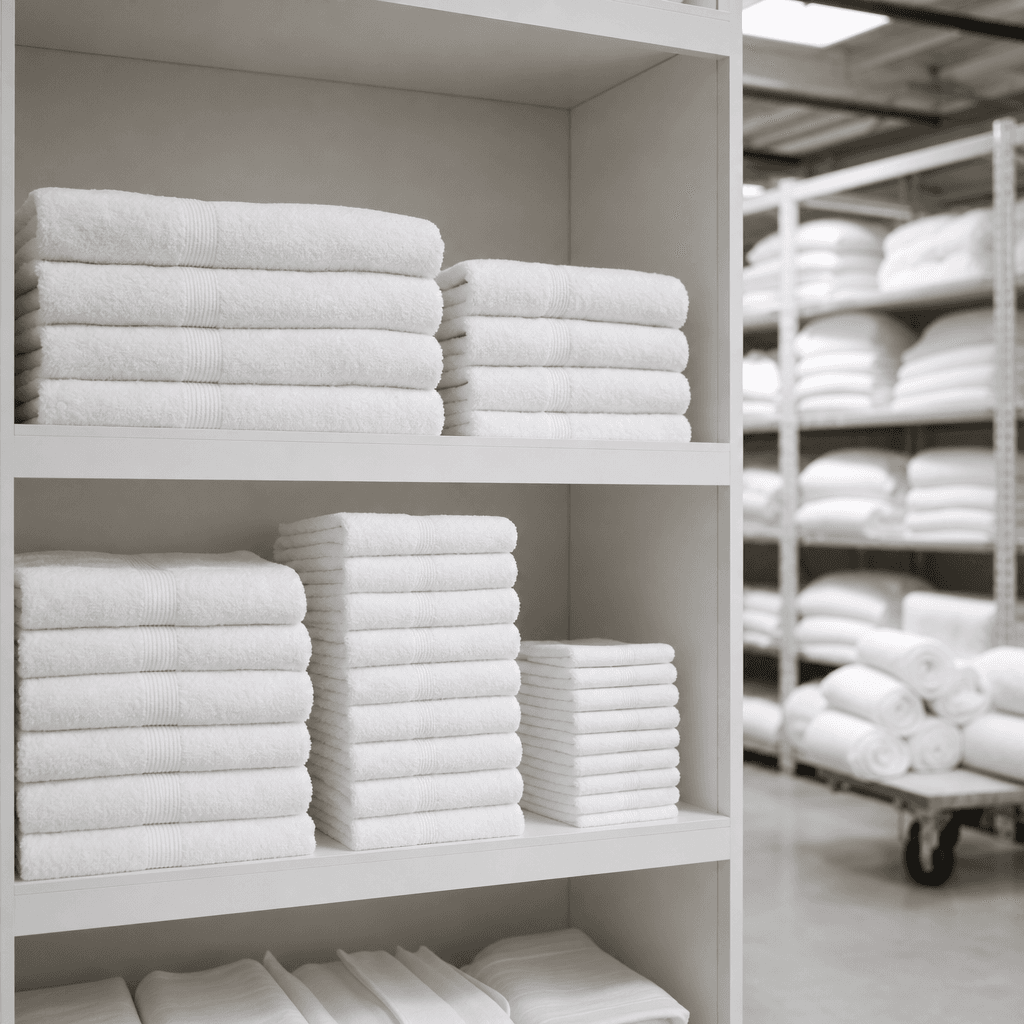
Match weight to the job. Motel and budget properties, gym locker rooms, and high-turnover pool decks do well with lighter towels because they dry fast and cost less to run through the dryer. Full-service hotels and day spas should look at the heavier end, since guests judge a property by the first towel they touch. Salons sit in the middle. Heavier towels cost more per unit and more to dry, so do not over-buy weight for a use that does not reward it. Our wholesale bath towels are built for real commercial volume, with tier pricing of 5% off at 5 units, 10% at 10 units, and 15% at 15 or more.
How do you calculate the true cost per use of wholesale bath towels, and when does paying more per unit save money over a full replacement cycle?
Unit price is the number everyone compares and the least useful one. The formula that matters is simple: divide the purchase price by the number of wash cycles the towel survives, then add your laundry cost per cycle. Take a hypothetical example. A cheap consumer-grade towel at $3.00 that frays and thins after 75 cycles costs $0.04 per use for the towel itself. A premium commercial towel at $6.00 that holds up for 250 cycles costs about $0.024. Add $0.10 in laundry per towel, and the commercial towel still wins, even though you paid double up front.
That example understates the gap, because it ignores labor and downtime. Every early replacement means a new purchase order, receiving, tagging, and rotating stock. It also means the awkward weeks when half your inventory is worn and the other half is new. Commercial-grade towels are built for 200+ wash cycles. Consumer retail towels typically fail somewhere between 50 and 100. The mistake we see most often is a buyer using consumer-grade towels in a commercial setting, then replacing them every 3 to 6 months instead of every 2 to 3 years with commercial grade.
Paying more per unit makes sense when your laundering is frequent and hard, as in hotels, gyms, and spas turning towels daily. It makes less sense for low-volume settings. A small guesthouse using each towel twice a week may never reach the cycle count that justifies the top tier. Run your own numbers using your actual cycles per month. Then use our volume tiers, since 15 or more units drops the price by 15%, which shifts the math further toward buying properly. If you stock vacation rental linens, par levels matter too. Three sets per bed is the common starting point so a turnover never leaves you short.
Which towel materials and weaves hold up best to heavy commercial laundering: ring-spun cotton, combed cotton, Turkish cotton, or cotton-poly blends?
Buyers search for "what is ring spun cotton towels" because the term gets thrown around loosely. Ring spinning twists and thins the cotton fibers into a finer, stronger yarn. The yarn is smoother and tighter than open-end yarn, so it sheds less lint and resists pilling. Combed cotton goes a step further. The fibers are combed to remove short ones before spinning, which leaves a longer, more uniform yarn. Combed ring-spun yarn is the strongest and softest common option, and it costs more.
For most commercial buyers, 100% cotton is the primary choice. It absorbs well, takes bleach, and feels right on skin. Turkish cotton is a long-staple fiber prized for softness and quick drying, and it suits spas and boutique hotels where feel is the product. It is not required for durability. Plenty of properties get excellent life from well-made ring-spun American-style terry. The weave and pile density matter as much as the fiber name on the tag.
Cotton-poly blends have a real place. Our economy and motel-grade towels are 86% cotton and 14% polyester. The polyester adds strength and cuts drying time, which saves energy at high volumes. The tradeoff is lower absorbency and a slightly less plush hand. For a budget motel or a gym towel that mostly handles light moisture, the blend is a sensible buy. For a spa where guests notice, go with 100% cotton. White remains the top choice for salons and hotels because it can be bleached and shows cleanliness. Black is growing in salons because it hides hair dye, though it fades faster under harsh chemistry, so confirm colorfastness before you buy. Hotels sourcing hotel towels wholesale should keep fiber and weave on the spec sheet, not just the brand name.
What should a purchasing manager check on a sample towel before placing a bulk order, from hem construction and pile retention to shrinkage and colorfastness?
Never place a 500-unit order off a catalog photo. Ask for a sample, then handle it like an inspector. Check the weight first. Put it on a scale and compare it to the stated lbs/dz for that size. Measure the towel flat. Then look at the hems. A good commercial towel has a double-needle stitched hem with tight, even stitches and no skipped loops. Pull gently at the corners. Cheap hems are the first thing to unravel, and a rolling or loose hem is a red flag.
Next, test pile retention. Rub the surface firmly with your palm, then pull at a loop with your fingernail. Heavy lint on your hand, or loops that pull out easily, signal short fibers and loose construction. Wet one corner and press it to your skin to judge absorbency. A new towel should take on water quickly. If it beads, there may be a silicone finish that washes out and leaves a different towel behind.
Then wash it. Run the sample through ten commercial-style cycles at your normal temperature and detergent, and measure it again. Cotton towels commonly lose a few percent in length and width, and anything beyond that range means they will not match your par stock after the first month. For colored or black towels, check the rinse water and compare the washed towel against an unwashed one. Industry methods for shrinkage and colorfastness are published by groups such as the American Association of Textile Chemists and Colorists, and a supplier should be able to tell you what testing standard they follow. We ship standard orders in 2 to 3 business days and custom or embroidered orders in 7 to 10, so there is time to run a proper sample test before a deadline. Washcloths at 12x12 and wholesale hand towels at 16x27 deserve the same checks as the bath sizes.
How can gyms, salons, and Airbnb hosts extend the life of wholesale bath towels through washing temperature, detergent choice, and fabric softener habits?
The best temperature to wash towels is a warm to hot wash, roughly 120 to 140 degrees Fahrenheit, with a hot dryer cycle to finish. That range cleans effectively and handles most body oils without punishing the fiber. Boiling-hot water every cycle shortens towel life and can set stains in the fabric. Gyms and salons dealing with bacteria or hair color should favor sanitizing practices recommended for their setting, and when a local health code sets a temperature rule, follow that first. Cold washes save energy but leave oils behind, which builds up and turns white towels gray.
Use a measured amount of detergent. More is not better. Excess detergent leaves residue that makes towels stiff and less absorbent, and it is the most common problem we hear about from first-time commercial buyers. Match the dose to load size and water hardness. Chlorine bleach works on white towels but should be used sparingly, since repeated heavy use weakens cotton. Oxygen-based brighteners are gentler and fit better for frequent cycles. Black and colored towels should skip bleach entirely.
Skip fabric softener, or use it rarely. Softener coats the fibers with a waxy film that cuts absorbency, which is exactly what a bath towel exists to do. If your towels feel rough, the cause is usually detergent buildup or hard water, and a vinegar rinse once a month usually fixes it. Do not overload the machine, and do not over-dry, because brittle, overheated fibers break down faster. Short, hot, well-rinsed cycles will get a commercial towel to 200 cycles and beyond, whether it lives in a gym, a salon, or a short-term rental.
Frequently Asked Questions
- What GSM range should hotels, spas, and salons look for when buying wholesale bath towels, and how does weight affect guest experience and cost?
- Standard bath towels are specified in lbs/dz and size, not GSM. An economy 20x40 runs about 4 lbs/dz, while a premium 24x50 runs about 10 lbs/dz. Heavier towels feel more luxurious and cost more to buy and dry, so match the weight to the guest experience you are selling.
- How do you calculate the true cost per use of wholesale bath towels, and when does paying more per unit save money over a full replacement cycle?
- Divide the purchase price by the number of wash cycles the towel survives, then add laundry cost per cycle. Commercial-grade towels last 200+ cycles against 50 to 100 for consumer towels, so paying more per unit usually wins wherever towels are washed daily.
- Which towel materials and weaves hold up best to heavy commercial laundering: ring-spun cotton, combed cotton, Turkish cotton, or cotton-poly blends?
- Ring-spun and combed 100% cotton give the best balance of strength and absorbency under heavy laundering. Turkish cotton adds softness for spas, and 86% cotton 14% polyester blends suit economy and motel use where drying speed and low cost matter most.
- What should a purchasing manager check on a sample towel before placing a bulk order, from hem construction and pile retention to shrinkage and colorfastness?
- Weigh and measure the sample, inspect the double-stitched hems, and rub the pile for lint and loose loops. Then run it through about ten wash cycles and check shrinkage, absorbency, and dye bleed before you order.
- How can gyms, salons, and Airbnb hosts extend the life of wholesale bath towels through washing temperature, detergent choice, and fabric softener habits?
- Wash warm to hot at about 120 to 140 degrees Fahrenheit, measure detergent carefully, and avoid regular fabric softener because it reduces absorbency. Use bleach sparingly on whites and not at all on black or colored towels.