
Towel Care and Maintenance Guide for Wholesale Linen Buyers
Towels are one of the biggest repeat linen costs a hotel, spa or salon carries. Buy the wrong weight or wash them badly, and you pay for the same stock twice in a year. These are five questions we hear from purchasing managers and housekeeping directors, answered from 59 years of wholesale linen work at Towel Depot.
[TLDR]TLDR: Buy by lbs/dz and fiber content, test samples before a big order, use the 5, 10 and 15 percent volume tiers wisely, wash warm with little softener, and expect 200+ cycles from commercial grade towels.[/TLDR]
What GSM range should hotels, spas, and salons look for when buying bath towels in bulk, and how does weight affect both guest experience and long-term cost?
Start with a correction. In the wholesale trade, standard terry towels are not sold by GSM. We specify them by size and by weight in pounds per dozen (lbs/dz). GSM only makes sense for specialty items like 900 GSM microfiber or a few 240 and 320 GSM products. If a supplier quotes GSM on a standard bath towel, ask for the lbs/dz figure too, because that is what lets you compare apples to apples.
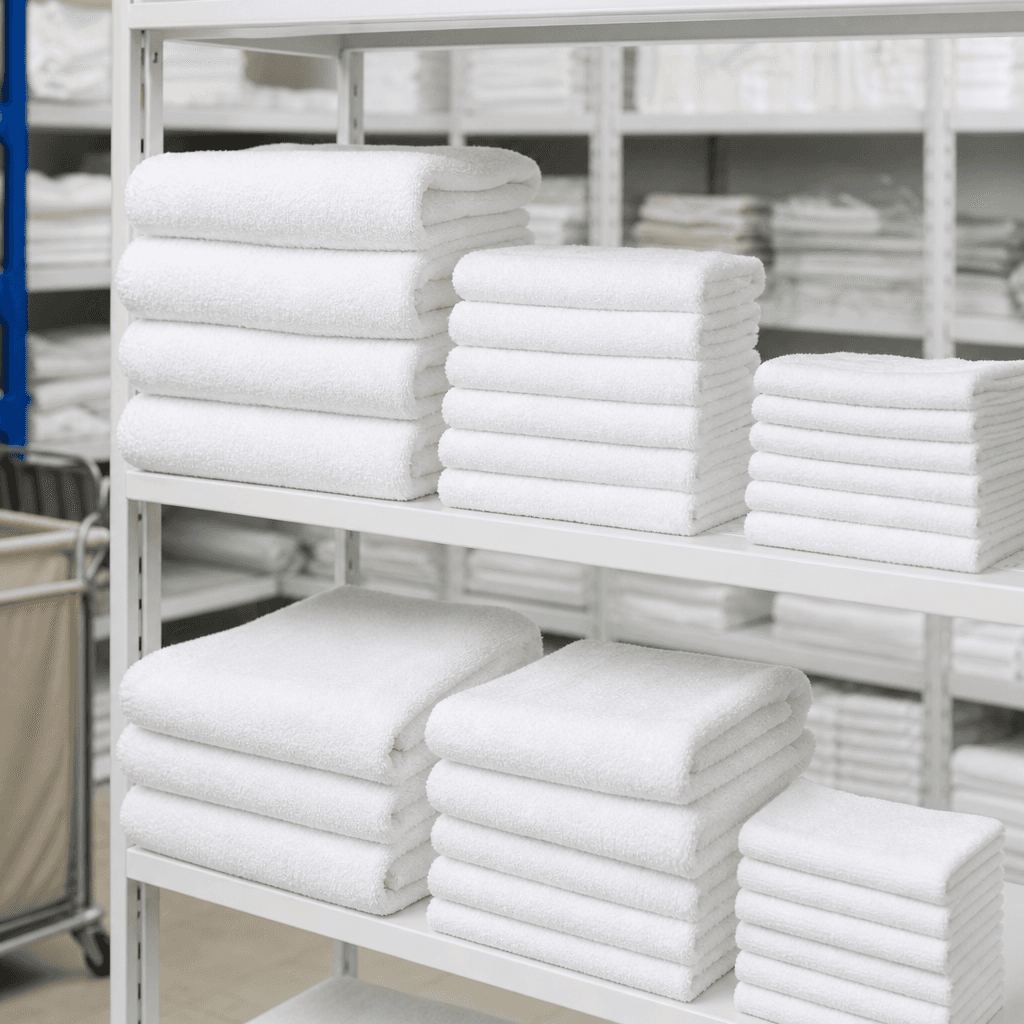
Here is how the range runs. An economy 20x40 bath towel weighs 4 lbs/dz. A premium 24x50 weighs 10 lbs/dz. Bath towels run from 20x40 up to 27x54, and bath sheets go to 30x60. Washcloths are 12x12 and hand towels are 16x27. A motel or budget property can live with the light end, often in an 86% cotton, 14% polyester blend. A full-service hotel or a day spa should be looking at 100% cotton in the heavier part of the range, because guests feel weight the moment they pick a towel up.
Weight also drives cost in ways people miss. A heavier towel costs more per piece, but it holds its shape, resists pilling, and survives more cycles. It also takes longer to dry and adds poundage to every laundry load, so your utility and labor cost per cycle goes up. Salons usually do fine in the middle, since clients use a towel for minutes, not a full morning. Our wholesale bath towels are sorted by size and lbs/dz so you can match the grade to the room instead of buying one spec for the whole building.
How can purchasing managers tell a high-quality cotton towel from a cheap one before committing to a large wholesale order?
Order a sample and put it through your own laundry. A showroom sample tells you nothing about what the towel looks like after ten washes. Wash it five to ten times at your normal temperature, then check shrinkage, lint, color and hand feel. A good 100% cotton towel loses a little length and still feels like terry. A cheap one comes out thinner, with loops that look flattened and a pile of lint in the trap.
Before the wash, check the basics. Read the fiber content on the spec sheet, and confirm the lbs/dz for the stated size. A 24x50 towel at 10 lbs/dz should feel dense and heavy in the hand, and a 20x40 at 4 lbs/dz will feel light, which is fine if that is what you ordered. Look at the hems. Tight, even stitching with a double-needle hem holds up in a commercial dryer. Loose or skipped stitches are where towels start to fray. Hold the towel up to a light. If you can see through the weave between loops, the density is low.
Absorbency is the other test. Drop a little water on a washed sample and see how fast it soaks in. New towels sometimes repel water because of finishing agents left from the mill, and that clears up after a few washes. If it still beads after five or six, the problem is usually the yarn or the finish. We see one mistake more than any other: buyers purchase consumer-grade towels for commercial use. Retail towels tend to fail at 50 to 100 cycles. Our commercial grade is built for 200+. We are family-owned and not a marketplace or dropshipper, so what we ship is what we have handled.
How do volume pricing tiers work when ordering towels wholesale, and at what quantity does the per-unit savings justify the storage and cash flow commitment?
Our tiers are simple and posted openly. You get 5% off at 5 units, 10% off at 10 units, and 15% off at 15 or more units. There is no negotiating dance and no hidden break at some number you only learn about at checkout. Most of our 10,000+ B2B clients, from hotels and gyms to hospitals, restaurants, Airbnbs and cruise lines, place orders of 100 to 500+ units, so the tiers are built around real commercial volume rather than a few retail pieces.
So where does the savings stop paying for itself? Think about it in terms of par levels. A property typically needs three to five sets of towels per room or station: one in use, one in the laundry, one on the shelf, and spares. Once your first order reaches the 15-unit tier, you have the full 15% discount, and going bigger does not lower the percentage further. That is the point where most buyers should stop and ask whether more stock is just cash sitting on a shelf. If you will use it inside a quarter or two, take the full tier. If you are buying a year ahead, the storage space and the tied-up cash usually cost more than the extra savings.
Our practical advice is to order to the 15-unit tier on your core white towels, since white is the top choice for salons and hotels. It bleaches clean and shows guests that the room is clean. Then stage the rest. Black is growing in salons because it hides hair dye, but color moves slower than white, so buy it in smaller lots. If you need a quick restock, standard orders ship in 2 to 3 business days. Custom and embroidered orders take 7 to 10 days, so build that into your reorder timing. Browse our bulk towels to see which items qualify for each tier.
What laundering practices (water temperature, detergent, fabric softener, drying) extend the life of commercial towels and keep them absorbent?
People search for the best temperature to wash towels all the time, and the honest answer depends on the towel and the soil. For white cotton towels in a hotel or spa, a warm to hot wash is standard, with bleach or an oxygen booster as needed. Colored and black towels do better with a cooler wash to protect the dye. Healthcare laundry follows stricter thermal rules, and the CDC environmental infection control guidelines are the reference to check if you serve clinical clients. Whatever you pick, keep it consistent. Wild swings in temperature wear fibers faster.
Now the question we get most: why are my 100 cotton towels not absorbent? In almost every case the culprit is buildup, not the towel. Fabric softener coats cotton loops with a waxy film, and the towel stops drawing water. Overdosed detergent does the same thing, leaving residue that traps water out. Skip liquid softener and dryer sheets on commercial terry. Use the detergent amount your chemical supplier recommends for the load size, and make sure you rinse well. If towels have already gone slick, run a hot wash with no softener and a measured amount of detergent, then another rinse. That often brings them back.
Drying matters as much as washing. Overloaded washers and dryers leave towels damp in the folds, which causes sour smells and mildew. Load machines to about three quarters full so the towels can tumble. Dry on medium to high heat until fully dry, but do not over-dry. Baked-out towels turn stiff and brittle, and the loops break. Clean your lint trap every load, as lint loss is also fiber loss. Last tip: keep towels away from benzoyl peroxide acne products and some salon chemicals, which bleach colored towels in spots. For the stained ones nobody can save, move them to the garage or maintenance team as bulk shop rags and stop sending them to guests.
How many wash cycles should a commercial towel last, and what signs tell a housekeeping director it is time to retire and replace a stock?
A properly made commercial towel should last 200 or more wash cycles. Consumer retail towels often give up at 50 to 100. In real terms that gap shows up on your budget. Buyers who start with consumer-grade towels end up replacing them every 3 to 6 months. With commercial grade, a property usually replaces stock every 2 to 3 years. Your own number will shift with your wash chemistry, how hard the staff handles the linen, and how many times a towel cycles each week. Track it. Put a date or a color-coded tag on each purchase lot so you know what you bought and when.
The signs of a tired towel are not subtle. Look for thin spots where you can see the weave, frayed or open hems, loops pulled out in snags, and a rough or flat hand feel. Check absorbency too. If a washed towel will not pick up water even after a stripping wash, it is finished. Gray or yellow cast that bleach will not fix is another sign, particularly on white stock. Smell matters. A towel that still smells musty after a clean wash has bacteria or mildew locked into the fibers.
Do not wait for a guest complaint to rotate stock. A good housekeeping director pulls a handful of towels each month and inspects them, then retires the worst. Rotate stock so every towel gets even use, which means you are not wearing out the top of the pile while the bottom sits fresh. When about a quarter of your inventory fails inspection, it is time to plan the next order, not after half is gone. Remember lead times. With standard shipping at 2 to 3 business days and custom work at 7 to 10, you can reorder without a gap if you start early.