
What Is The Best Material For Bathrobes
In this guide:
- Cotton vs Microfiber in Commercial Settings
- Choosing the Right GSM Weight for Your Business
- Absorbency and Drying Time by Material
- Durability Under Commercial Laundering
- Best Value for Bulk Orders of 100 to 500 Units
- Frequently Asked Questions
If you manage a hotel, spa, salon, gym, or restaurant, choosing the best material for bathrobes directly affects your operational costs and guest satisfaction. Your buyers order in quantities of 100 to 500 units. Each robe must withstand hundreds of industrial wash cycles while staying soft and absorbent. This guide covers the five materials that matter most in wholesale decisions: cotton terry, microfiber, velour, waffle weave, and flannel. We focus on real numbers: GSM weights, wash cycle counts, drying times, and cost per use.
For most commercial applications, 100% cotton terry cloth at 400 to 600 GSM offers the best balance of absorbency, durability, and comfort. Microfiber is a budget friendly alternative if fast drying matters more than longevity. Avoid silk and fleece for high turnover environments.
Cotton vs Microfiber: Which Is Better for High Traffic Hospitality Environments?
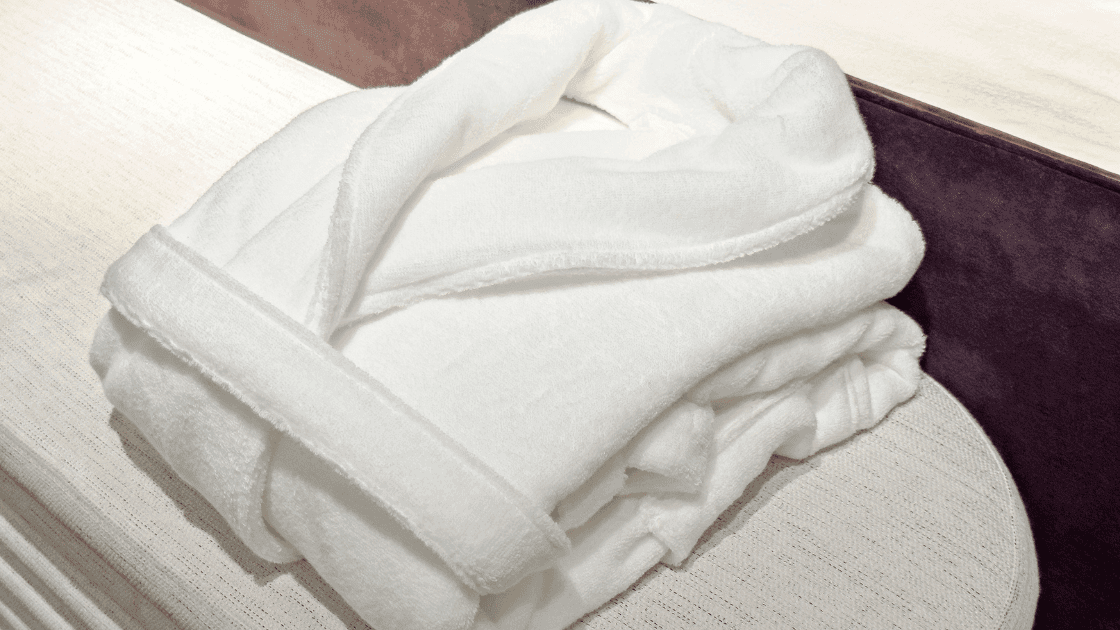
Cotton terry cloth has been the industry standard for decades. A 450 GSM cotton terry robe absorbs up to 2.5 times its weight in water. It can handle 180 to 200 commercial wash cycles at 160 degrees Fahrenheit (71 degrees Celsius) before the loops begin to thin. With proper care, you get 18 to 24 months of daily use per robe. That makes cotton terry the most reliable choice for hotels and spas where every robe gets used and laundered daily.
Microfiber robes are made from polyester and polyamide blends. They dry about 40% faster than cotton because the fibers do not hold water internally. A 200 GSM microfiber robe dries in 20 to 25 minutes in a commercial dryer set at 140 degrees Fahrenheit (60 degrees Celsius). Cotton terry of the same weight takes 35 to 45 minutes. Faster drying means lower energy bills and quicker turnaround between guests. However, microfiber loses absorbency after about 100 washes. The fibers also pill more easily, especially under high heat. For a gym or salon where robes rotate quickly, microfiber works well. For a luxury hotel where guests expect plush comfort, cotton wins.
Cost per use tells the real story. A bulk cotton terry robe at $15 per unit and 200 washes costs $0.075 per wash. A microfiber robe at $11 per unit and 100 washes costs $0.11 per wash. The cotton robe is 32% cheaper per wash despite the higher upfront price. When ordering 500 units, the total difference over the life of the robes is nearly $2,000. That is why most commercial linen suppliers recommend cotton terry for long term value.
What GSM Weight Should You Choose for a Commercial Bathrobe?
GSM stands for grams per square meter. It measures fabric density. For bathrobes, GSM determines warmth, absorbency, drying time, and price. Low GSM robes (300 to 400) are lightweight and dry fast. They work well for gyms and summer resort properties. A 350 GSM robe feels like a thin towel. It absorbs about 1.5 times its weight and dries in 20 to 30 minutes. These robes cost less upfront, typically $8 to $12 per unit in bulk. But they wear out faster, often showing thinning after 120 washes.
Mid GSM robes (400 to 600) are the sweet spot for most commercial buyers. A 500 GSM cotton terry robe feels substantial without being heavy. It absorbs 2 to 2.2 times its weight. It lasts through 180 to 200 washes if laundered at 160 degrees Fahrenheit (71 degrees Celsius) and dried at medium heat. These robes cost $13 to $18 per unit in orders of 100 to 500. For a typical hotel, this GSM range gives the best return. Your guests get a cozy robe. Your laundry budget stays under control.
High GSM robes (600 to 900) are luxury items. A 700 GSM robe is thick and plush. It absorbs nearly 3 times its weight. But it takes 45 to 60 minutes to dry at 140 degrees Fahrenheit (60 degrees Celsius). The extra drying time increases utility costs and slows turnaround. High GSM robes also wear out faster because the heavy loops break under mechanical stress. Expect 120 to 150 washes before noticeable deterioration. These robes are best for high end spas that charge premium rates and can afford frequent replacement. For most B2B buyers, 400 to 500 GSM gives the best balance.
How Do Different Bathrobe Materials Perform in Terms of Absorbency and Drying Time?
Absorbency matters most for guests stepping out of a shower or pool. Cotton terry leads the category, absorbing 2 to 2.5 times its dry weight. A 500 GSM cotton robe holds about 1,200 grams of water. It releases that water slowly, which keeps the wearer dry but extends drying time. In a commercial dryer at 140 degrees Fahrenheit (60 degrees Celsius), a cotton terry robe takes 35 to 45 minutes to reach 0% moisture content. That is the standard for most hotel laundries.
Waffle weave cotton is a lighter alternative. The open grid pattern allows air to circulate. A 350 GSM waffle robe absorbs about 1.8 times its weight but dries in 18 to 25 minutes. That is 30% faster than terry of the same weight. Waffle robes work well for spas where guests want quick drying between treatments. Velour robes have a cut pile that feels smooth but absorbs less water, about 1.5 times their weight. They take 40 to 50 minutes to dry because the dense surface traps moisture. Velour is more about luxury texture than utility.
Microfiber dries fastest of all. A 250 GSM microfiber robe absorbs only 1.2 to 1.4 times its weight, but it releases that water in 20 to 25 minutes. That is 40% faster than cotton terry. For a gym where guests use robes briefly, microfiber cuts laundry cycle time significantly. Flannel robes are not designed for wet use. They absorb only 1 times their weight and take 30 minutes to dry. Flannel is better for lounging before bath or post shower when the body is already dry. Consider your facility’s average use case before choosing.
What Are the Most Durable Bathrobe Materials for Commercial Laundering?
Commercial laundry is hard on textiles. High heat, strong detergents, and mechanical abrasion break down fibers over time. Cotton terry with double stitched hems and reinforced seams survives 150 to 200 industrial wash cycles. The key is the weave density. A 500 GSM terry with a tight loop structure holds up longer than a loose 300 GSM weave. Wash at 160 degrees Fahrenheit (71 degrees Celsius) to sanitize per CDC guidelines for healthcare and hospitality linens. Dry at 140 degrees Fahrenheit (60 degrees Celsius) to avoid overheating the cotton. CDC laundry guidelines recommend these temperatures for pathogen reduction.
Microfiber robes last 80 to 120 cycles before they start to pill and lose shape. The polyester fibers degrade faster under high heat. Never wash microfiber above 140 degrees Fahrenheit (60 degrees Celsius). Use a gentle cycle to reduce friction. Even so, the lifespan is half that of cotton terry. For high turnover environments like hotel chains, cotton terry is the better investment. Velour robes have a similar lifespan to microfiber, about 100 cycles, because the cut pile frays easily. Waffle weave cotton falls between 120 and 150 cycles because the open structure puts less stress on individual yarns.
Flannel robes rated for commercial use last 80 to 120 washes. The brushed surface fades and thins quickly. For salons where robes are used for short periods and washed multiple times per day, flannel is not cost effective. Always check the care label for maximum fabric shrinkage. Cotton robes can shrink 3% to 5% after the first few washes. Pre shrunk robes cost a bit more but hold size longer. The FTC care labeling guidelines require accurate shrinking information. Ask your supplier for test reports before placing a large order.
Which Bathrobe Material Offers the Best Value for Bulk Orders of 100 to 500 Units?
Value is not just the unit price. It is the cost per use over the robe’s lifespan. Cotton terry at 400 GSM gives the best ROI for most businesses. A typical bulk price for a 400 GSM cotton terry robe is $12 to $15 per unit. With a life of 180 washes and an average of 1 wash per use, that is $0.067 to $0.083 per use. Add detergent and energy costs of roughly $0.05 per wash, and total cost per use is $0.117 to $0.133. For a hotel with 200 robes, each used 300 times per year, that is an annual cost of about $7,000 to $8,000.
Microfiber robes cost less upfront, $9 to $12 per unit in bulk. But they last only 100 washes, giving a cost per use of $0.09 to $0.12. The faster drying saves $0.02 to $0.03 per wash in energy. Adjusted for energy savings, the net cost per use is $0.07 to $0.09. That is actually lower than cotton per use if you only count laundry energy. However, replacement costs climb because you buy new robes sooner. Over 3 years, a 500 unit microfiber order needs replacement at 18 months, while cotton terry lasts 24 months. The three year total for microfiber is about $15,000 more than cotton terry.
Velour and flannel are luxury options that cost $18 to $25 per unit. They last only 100 to 120 washes. Their cost per use is $0.15 to $0.25, making them the most expensive over time. Waffle weave at $14 to $17 per unit and 130 to 150 washes comes in at $0.09 to $0.11 per use. For a high end spa that charges for robe use, velour may justify the cost. For standard hotel or gym operations, cotton terry at 400 to 500 GSM is the clear winner. Always request samples and test wash cycles before committing to a bulk order. OSHA guidelines for commercial laundry also require safe handling procedures for wet linens, which can affect your workflow.