
Shop Rags: Complete Buyer's Guide for Industrial Operations
Choosing the right shop rags affects your operation's efficiency, safety protocols, and monthly supply costs. Industrial buyers face decisions about cotton versus synthetic materials, washing versus replacement strategies, and volume purchasing that directly impact their bottom line. These decisions become more complex when you factor in commercial washing requirements, contamination risks, and workplace safety standards.
Reclaimed 100% cotton surgical huck rags offer superior absorbency and durability for industrial use, while proper washing protocols extend their lifespan to 200+ cycles compared to synthetic alternatives that fail at 50-100 cycles.
Should you wash and reuse cotton shop rags or treat them as disposable?
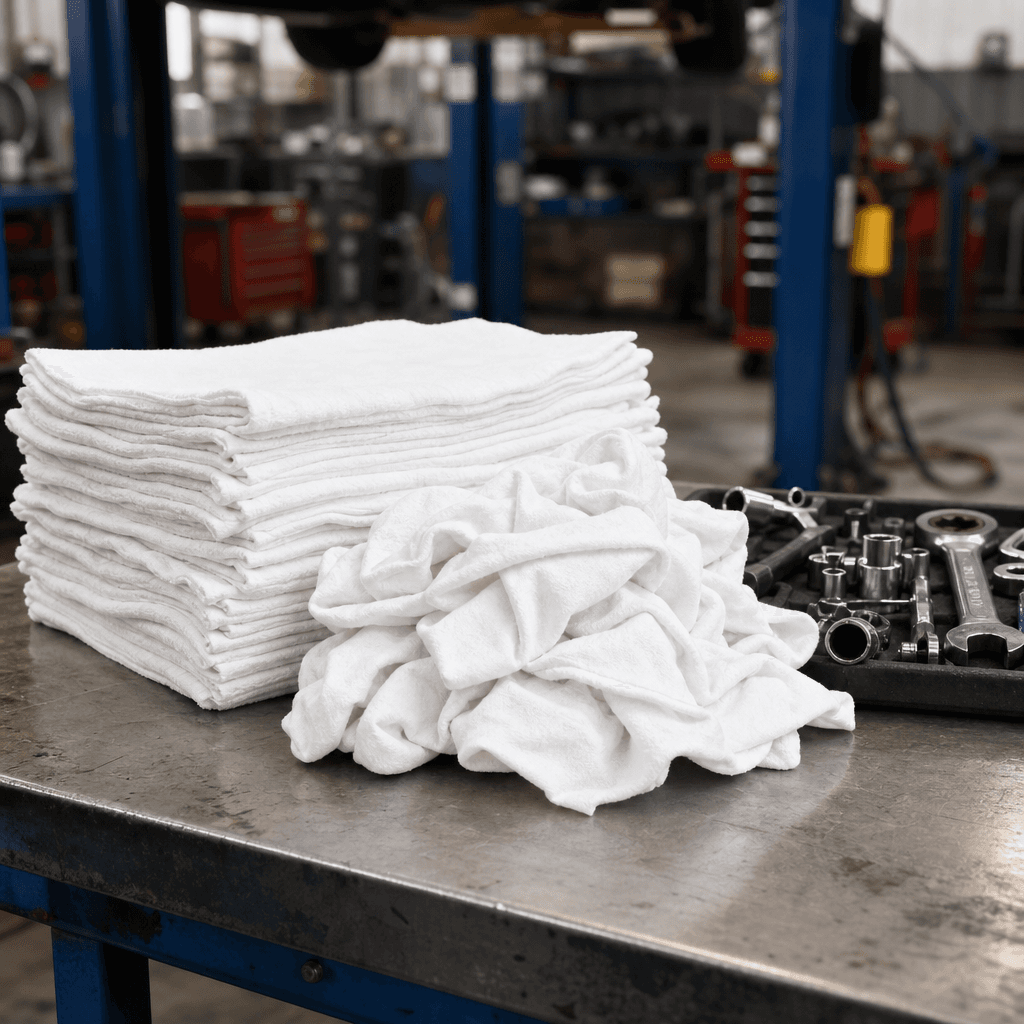
Cotton shop rags, particularly reclaimed surgical huck towels, are designed for multiple wash cycles and perform better with each cleaning when properly maintained. Our reclaimed 100% cotton surgical huck rags withstand 200+ commercial wash cycles while maintaining their lint-free properties and absorbency rates. This durability comes from the tightly woven construction originally designed for medical environments where lint contamination could compromise sterile procedures.
The economics favor washing and reuse for most industrial operations. A 10 lb bag of 14x14 cotton huck rags contains approximately 80-90 individual towels. At commercial washing costs of $0.25-0.35 per pound, each wash cycle costs roughly $2.50-3.50 for the entire bag. Over 200 wash cycles, this represents a cost per use of approximately $0.03-0.04 per rag per cycle, compared to $0.15-0.25 for disposable alternatives.
However, disposal becomes necessary when rags are contaminated with hazardous materials, petroleum products that create fire risks, or substances that violate local wastewater regulations. OSHA guidelines require proper disposal of rags soaked in flammable solvents, and many facilities maintain separate collection systems for contaminated versus reusable shop rags to ensure compliance with workplace safety standards.
Can washing heavily soiled shop rags damage commercial washing machines?
Commercial washing machines handle heavily soiled shop rags better than residential units, but proper preparation prevents costly damage and extends equipment life. The key concern is removing metal shavings, wood chips, and large debris before the wash cycle. Many facilities install pre-wash shaking and debris removal stations where workers shake out rags over collection bins, removing particles that could damage pump impellers or clog drain systems.
Grease and oil contamination requires different handling protocols. Heavy petroleum products should be removed through solvent pre-treatment or disposal rather than washing, as they can create film buildup on machine components and violate wastewater discharge permits. For moderate grease contamination, commercial degreasing agents and hot water cycles (160-180°F) effectively remove oils without machine damage. Our 59-year experience in wholesale linen supply has shown that facilities washing shop rags properly see minimal equipment issues compared to those attempting to wash inappropriate materials.
The washing frequency and load distribution also matter. Running shop rags separately from other linens prevents cross-contamination and allows for appropriate water temperatures and chemical treatments. Commercial operations typically dedicate specific wash cycles to shop rags, using extended wash times and higher chemical concentrations than standard linen processing. This separation protects both the washing equipment and other textile inventory from contamination and damage.
What's the most cost-effective approach: washing shop rags or replacing them?
Cost analysis depends on contamination levels, facility washing capabilities, and local disposal costs. For facilities with commercial laundry access, washing cotton shop rags becomes cost-effective after the third use cycle. A 50 lb bag of reclaimed cotton surgical huck rags costs approximately $85-95, containing roughly 400-450 individual rags. Over 200 wash cycles, the cost per use drops to $0.02-0.03 per rag, while disposal costs range from $0.15-0.30 per rag depending on local waste management fees.
Facilities processing light to moderate contamination see the best returns from washing programs. Auto shops, manufacturing plants, and maintenance facilities handling standard lubricants, coolants, and general cleaning tasks typically achieve 150-250 wash cycles per rag. The break-even point occurs around cycle 8-12, after which each additional use represents pure cost savings. Volume purchasing through wholesale shop rags programs further reduces per-unit costs through quantity discounts.
Replacement strategies make sense for high-contamination environments or facilities lacking proper washing infrastructure. Chemical processing plants, paint shops, and operations dealing with hazardous materials often opt for disposal to maintain safety compliance and avoid cross-contamination risks. However, even these facilities often maintain dual systems, using disposable rags for contaminated work and washable cotton rags for general cleaning tasks. This hybrid approach optimizes both cost and safety requirements.
Why do some shop rags smear rather than absorb liquids effectively?
Smearing occurs when shop rags contain synthetic fibers that repel rather than absorb liquids, or when fabric treatments create hydrophobic surfaces. Polyester blends, commonly found in lower-cost shop rags, have synthetic fibers that push oils and water across surfaces instead of drawing them into the fiber structure. This problem becomes more pronounced with petroleum products, where synthetic materials create a barrier effect that spreads contamination rather than containing it.
Fabric softeners and chemical treatments also contribute to smearing issues. Many commercial laundries use fabric softeners that coat fibers with waxy residues, reducing absorbency and creating slippery surfaces that can't grip liquids effectively. Our reclaimed 100% cotton surgical huck rags avoid this problem because they're processed without softening agents and maintain their natural cotton fiber structure that creates capillary action for liquid absorption.
The weave pattern significantly impacts absorption characteristics. Loosely woven rags may appear more absorbent but often lack the fiber density needed for effective liquid retention. Tightly woven cotton huck towels, originally designed for medical use, provide optimal balance between absorption capacity and liquid retention. The 14x14 and 15x26 sizes we stock offer sufficient surface area for most industrial applications while maintaining the tight weave structure that prevents smearing and ensures complete liquid pickup.
What makes cotton shop rags superior to polyester blends for industrial use?
Cotton's natural fiber structure creates superior absorbency through capillary action, while polyester's synthetic composition repels liquids and creates safety hazards in industrial environments. Pure cotton fibers have hollow cores and rough surfaces that trap and hold liquids, oils, and particulates effectively. Polyester blends reduce this capability because synthetic fibers are smooth and non-absorbent, creating gaps in the material's overall absorption capacity and leading to incomplete liquid pickup.
Heat resistance represents another critical advantage for industrial applications. Cotton withstands higher washing temperatures (up to 200°F) without melting or degrading, allowing for effective sanitization and grease removal. Polyester fibers begin softening around 180°F and can melt at higher temperatures, potentially damaging washing equipment and creating safety hazards. This temperature tolerance also matters during use, as cotton rags can safely contact warm machinery and components without risk of melting onto surfaces.
Lint production patterns also favor cotton for industrial use. While cotton initially produces more lint than synthetic materials, this lint consists of natural fibers that break down harmlessly in waste streams and don't create respiratory concerns. Synthetic lint from polyester blends creates microplastic contamination and can cause respiratory irritation in enclosed work environments. Our reclaimed surgical cotton huck rags minimize lint production through their medical-grade processing, providing the benefits of cotton without excessive fiber shedding. The lint-free characteristics make them suitable for precision work environments where contamination control matters, similar to applications requiring wholesale bath towels in hospitality settings where cleanliness standards are paramount.