
Salon Towels: Complete Buyer's Guide for Professional Salons
In this guide:
- What GSM weight is best for salon towels?
- How often should salons replace their towels?
- What is the ideal washing temperature for salon towels?
- Should salons use white or colored towels?
- Are cotton blend towels better than pure cotton for salons?
- Frequently asked questions
Choosing the right salon towels directly affects your clients' comfort and your daily operations. When you buy in bulk for a professional salon, every towel must perform through hundreds of wash cycles without soaking through or fraying. This guide gives B2B buyers the hard numbers on GSM weight, replacement timing, and washing protocols so you can order with confidence from Towel Depot, your wholesale linen supplier since 1967.
Commercial salon towels require 400 to 600 GSM density, a 6 to 9 month replacement cycle, and proper washing at 140°F (60°C) to maintain professional standards while controlling costs.
What GSM weight is best for salon towels?
GSM stands for grams per square meter. It is the industry standard for measuring towel density and absorbency. For salon use, you want a GSM between 400 and 600. The sweet spot is 500 GSM. This weight gives enough absorbency for wet hair, color services, and shampoo sessions without being so heavy that the towel becomes unwieldy during treatment. Towels under 400 GSM will soak through quickly. Your client will end up with water on their clothing or cape. That is a fast way to lose repeat business.
Retail towels sold in department stores typically run 200 to 300 GSM. They are designed for light home use, not for the water volume of a professional shampoo bowl. A 300 GSM towel holds about half the water a 500 GSM towel holds. When you are doing eight clients a day per stylist, that difference adds up in lost time for re drying or placing extra towels. You want one towel per client that works the first time.
Weave construction matters just as much as weight. Look for terry cloth with long loops. Long loops create more surface area to trap water. Towels with short loops or low pile density will feel thin and shed lint on your clients. Test a sample by holding it up to light. If you see pinprick holes, the loops are too short. Stick with 500 GSM terry cloth for the best balance of performance and cost in a wholesale salon towels order.
How often should salons replace their towels?
Monthly inspections are your best tool. A commercial salon towel will last 200 to 300 wash cycles under normal conditions. That translates to roughly 6 to 9 months of daily use. After that, the cotton loops start to break down. You will see frayed edges, loose threads, and a loss of absorbency. Replace towels as soon as you notice any of these signs. Waiting costs you time and reputation.
Wash cycle counts matter more than calendar dates. If your salon does 50 towel loads per week, you will hit 300 cycles faster than a small shop doing 20 loads. Keep a simple log. Write the date you put a batch of towels into service. Check them every 4 weeks. When the pile feels flat or the towel no longer picks up water the way it did, order new stock immediately. Do not try to squeeze another month out of worn towels. They will leave lint on clients and fail during service.
Proper washing extends towel life. Use a high temperature wash of 140°F (60°C) to kill bacteria and remove oils. Avoid fabric softener and bleach alternatives that coat fibers. And never overload the washing machine. Overcrowding stops towels from agitating properly. Detergent gets trapped in the folds. Oils and residues build up. That buildup accelerates fiber breakdown. With proper care, a 500 GSM blend towel can reach 250 cycles. Without care, you might see failures at 150 cycles. Pay attention to your laundry process and you will save money on replacements.
What is the ideal washing temperature for salon towels?
Wash salon towels at 140°F (60°C). This temperature kills bacteria, mold, and other pathogens that grow in damp towels. It also breaks down the oils and styling products that build up in the fibers. Health codes for salons in many states require water hot enough to sanitize. Check your local regulations. The OSHA guidelines on bacterial contamination recommend hot water for laundered fabrics in professional settings. Stay at or just above 140°F for safety.
Do not go above 160°F (71°C) on a regular basis. That extreme heat will shrink cotton fibers and shorten towel life. You may need to boil out heavy grease or color stains occasionally, but make that an exception. For everyday loads, 140°F is enough. Use a detergent that is free of optical brighteners and fragrances. These additives leave residues that reduce absorbency. And never use fabric softener. Fabric softener coats cotton fibers with a waxy layer. That layer repels water. Your towels will stop absorbing almost overnight if you use softener.
Dry towels at moderate heat. High heat in the dryer also damages fibers. Tumble dry on medium until towels are just dry. Overdrying makes the loops brittle. When you pull a towel from the dryer, it should feel slightly warm but not hot. Fold immediately to reduce wrinkles. If you are washing 100 or more towels per day, invest in a commercial washer with a high temperature setting. A residential machine cannot maintain consistent 140°F water for a full cycle. Your salon towels will last longer with the right equipment.
Should salons use white or colored towels?
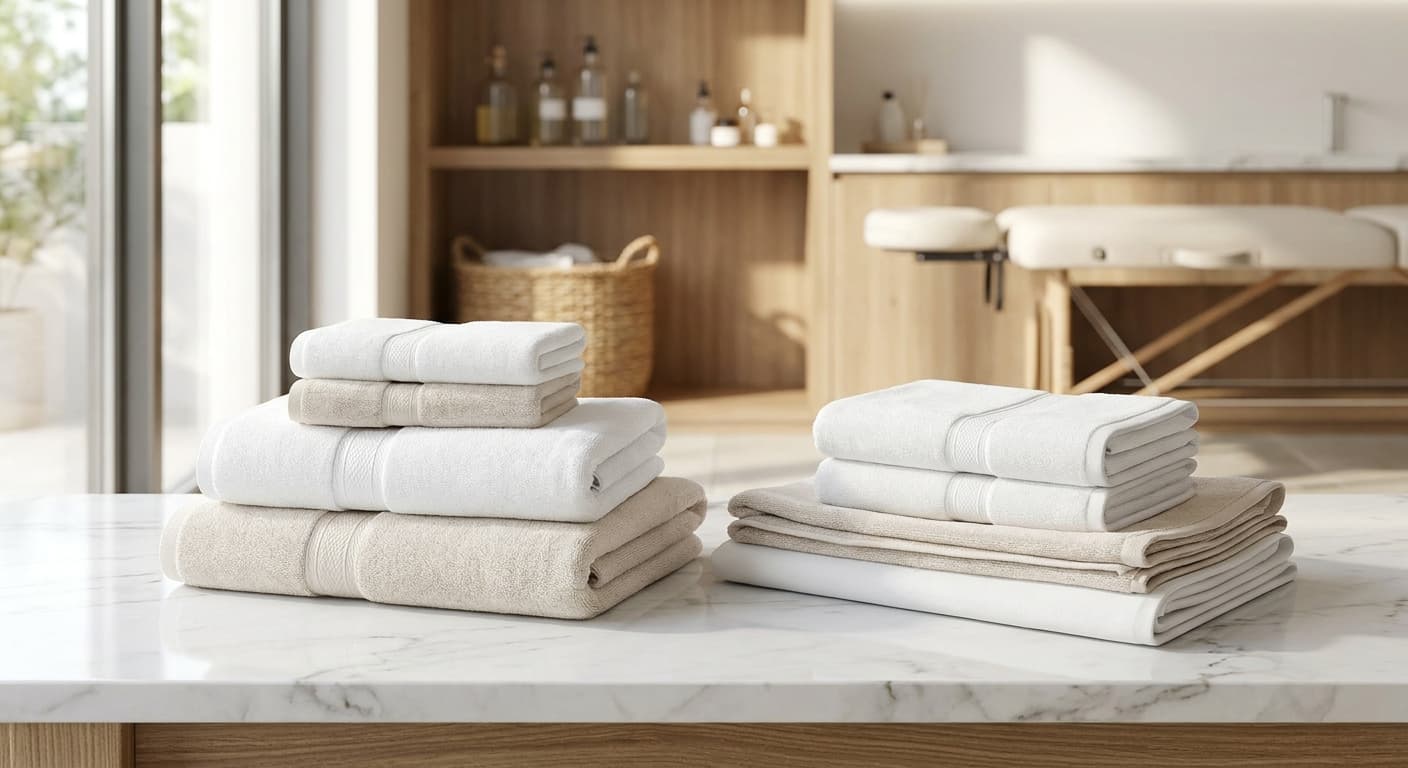
White towels are the standard for good reason. They can be bleached safely without damaging the fabric. Chlorine bleach kills bacteria and removes stains from hair dye and toner. White towels also make it easy to spot dirt or mildew. You see exactly when a towel is ready for replacement. For a high volume salon, white is the most practical color choice for controlling hygiene and inventory.
Dark towels, especially black or charcoal, hide dye stains well. That is their main advantage. But they come with trade offs. You cannot bleach dark towels. Bleach will strip the color and leave uneven patches. Instead, you must use color safe oxygen bleach or hydrogen peroxide. These products are less effective at killing certain bacteria. And dark fibers make it harder to see when a towel is truly clean or when it has developed a mildew smell. You only notice the problem when you pick up the towel and smell it.
If you choose dark towels, set up a separate laundry stream. Wash dark towels separately from light ones to prevent color transfer. Use a detergent formulated for darks. Wash at 140°F but skip bleach. Add a sanitizer approved for colored fabrics. Check the water pH regularly. Hard water can cause dye to bleed faster. And replace dark towels more often. The dye will fade after about 150 washes, while white towels stay white for 200 to 250 washes. For most salons, a mixed inventory works best: white for shampoo and general use, dark for color services only.
Are cotton blend towels better than pure cotton for salons?
Yes, an 80% cotton and 20% polyester blend outperforms pure cotton in a commercial salon. Pure cotton is soft and absorbs well initially. But it breaks down after about 100 to 150 wash cycles. The cotton loops snap, the towel loses its pile, and it begins shedding lint on clients. Polyester reinforces the cotton fibers. The blend maintains its shape and absorbency through 200 to 250 cycles. That is nearly double the lifespan of pure cotton.
Blended towels also dry faster. Polyester does not hold water the way cotton does. A blend towel dries about 20% faster in the dryer. That means less energy use and quicker turnaround between loads. In a busy salon with multiple stylists, you need towels back in circulation fast. A pure cotton towel takes longer to dry and comes out heavier. The blend feels lighter and more flexible. It is easier to fold and store.
Softness is a concern for some buyers. Modern blend towels are much softer than the scratchy polyester towels of the past. The cotton content gives a natural feel against the skin. The polyester adds strength without noticeable texture. Test a sample for yourself. Run a blend towel through 20 wash cycles and feel it. It will be softer than the first wash. Pure cotton may feel softer initially but will become rough and thin over time. For salons ordering in volume of 100 to 500 units, the blend offers the best return on investment. Pair your wholesale bath towels with blend salon towels for consistent quality across your linen inventory.