
Restaurant Towels: Wholesale Buying Guide for Kitchens & Bars
Restaurant towels look like a small line item until you count how many a busy kitchen goes through in a week. A 120-seat room can use dozens per shift, and the wrong spec means constant rewashing, replacing and reordering. These are five questions we hear from buyers, answered from 59 years of wholesale linen experience.
[TLDR]TLDR: Buy 100% cotton herringbone kitchen towels at 24 oz in 15x26 or 16x27 for most work, add microfiber only for glass, wash hot with real detergent and no softener, and expect 2 to 3 years from commercial grade instead of 3 to 6 months from retail.[/TLDR]
What GSM and weave should purchasing managers look for when buying restaurant towels in bulk for kitchens, bars, and front-of-house service?
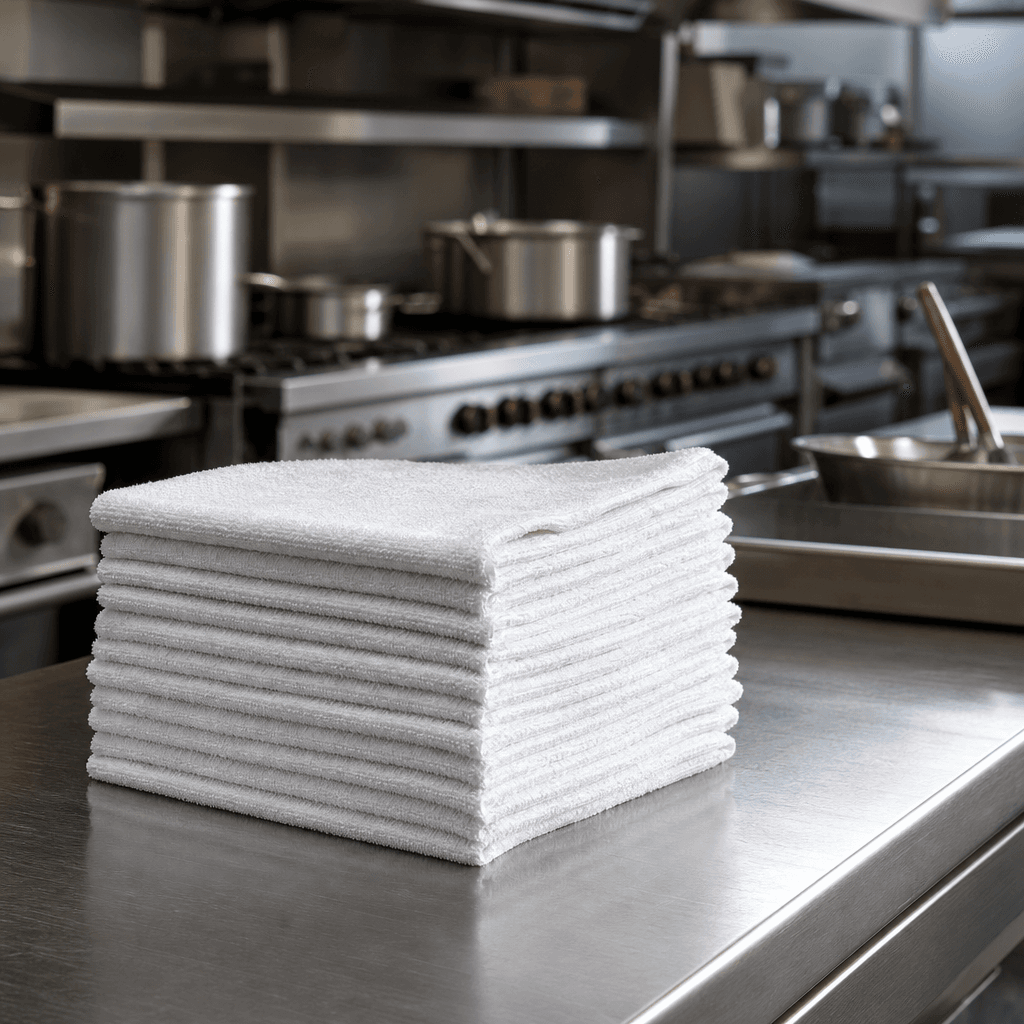
Start with the product that does most of the work. Our standard kitchen towel is 100% cotton, herringbone weave, with a blue center stripe, 24 oz, in 15x26 or 16x27. Some customers call it a bar mop and others call it a kitchen towel. It is the same towel. Trade weight is quoted per dozen, so 24 oz means about 2 oz per towel. Run that through the sizes and you land at roughly 200 to 225 GSM, which is a medium weight that absorbs fast, rinses clean and dries overnight on a rack.
Herringbone matters more than people expect. The tight, zigzag structure gives you a flat surface that grips grease and moisture without leaving lint on stainless or glassware. Looped terry is thicker, but it holds water longer and takes more dryer time. For prep tables, line wipe-downs and bar rails, a flat herringbone weave is the working standard for a reason. If you are pricing bulk towels for several departments, buy the kitchen towel as your base and add other types only where a task demands it.
Front-of-house is a different story. Table linens and napkins are 100% spun polyester, not cotton. Spun poly resists stains, comes out of the dryer nearly wrinkle-free and survives the bleach and heat of a commercial laundry. Napkins run 20x20 as the standard, 22x22 for a fuller look, and 21.5x41 for banquet service. Cotton Momie napkins are the premium exception, and they suit fine dining rooms that want a softer hand. Do not let a quote describe a standard tablecloth as cotton. It almost never is.
How can hotels, spas, and salons tell whether a restaurant towel is built to survive 150 or more commercial wash cycles before they place a large order?
You cannot learn it from a product photo, so ask for the construction details. Commercial-grade towels are built for 200+ wash cycles. Consumer retail towels typically fail at 50 to 100. That gap is the whole story of why we see the same mistake again and again. A buyer grabs consumer-grade towels for commercial use and replaces them every 3 to 6 months. A buyer on commercial grade replaces them every 2 to 3 years. The shelf price is lower, but the cost per use is much higher.
Check three things on the sample. First, the hem. A double-stitched, tight hem resists unraveling in the tumble dryer. Second, the yarn. Open the fabric and look for long, even fibers rather than fuzzy, short ones that shed lint after a few washes. Third, the weight against the stated spec. Weigh a dozen on a postal scale. A 24 oz kitchen towel that weighs 20 oz is a thinner towel with a bigger claim on the label.
Then run your own test. Wash a sample 25 times at your actual laundry settings, not gentle home settings, and compare it with a new one. Look at shrinkage, hem condition, color retention and how fast a spill soaks in. Salons and spas should also confirm they are buying bleach safe towels, which is why white remains the top choice for hotels and salons. It tolerates bleach and shows cleanliness. Black is growing in salons because it hides hair dye, but bleach will damage it, so it needs a dye-safe routine. Pool and spa operators who also stock wholesale beach towels should test those separately, since heavier terry behaves differently in the dryer.
What is a realistic per-towel price range for wholesale restaurant towels, and how do case quantities, fabric weight, and color choices change the true cost per use?
Wholesale pricing moves with weight, size and order volume, so check the current figure on the product page before you budget. What does not move is the structure of our tiers. B2B buyers typically place orders of 100 to 500+ units, and our minimums and pricing are built for that. Volume discounts are transparent: 5% at 5 units, 10% at 10 units and 15% at 15+ units. A buyer who orders one case a month pays more than one who consolidates a quarter's needs into a single larger order.
Here is the math that actually counts. Say a commercial towel costs twice what a retail towel does but lasts 200+ washes against 50 to 100. Even on the conservative end, you are getting double the life or better, and you are not paying for the labor of ordering, receiving and swapping towels four times a year. Add the 15% tier and the gap widens. Cost per use is the only honest comparison, and it nearly always favors the heavier, better-built towel.
Color changes the cost too. White is the easiest to keep consistent because you can bleach it back. Dyed towels cost a little more to color-match across reorders and fade faster under hot water and chlorine. Many kitchens use the blue center stripe to separate kitchen use from other linens, which saves you from buying a second color system. Ship times matter for planning. Standard orders go out in 2 to 3 business days, and custom or embroidered orders take 7 to 10 days, so build that into your par levels before you run short.
How should buyers choose between cotton, cotton-poly blend, and microfiber restaurant towels for different tasks like glass polishing, spill cleanup, and equipment wipe-downs?
Match the fiber to the job. For spill cleanup and general wipe-downs, 100% cotton wins. It absorbs quickly, takes high heat and bleach, and stays soft after hundreds of cycles. The terry cloth vs microfiber question comes up constantly, and the short answer is that terry cotton holds more water and handles abuse, while microfiber grabs fine dust and leaves less lint. Neither is better everywhere.
For glass polishing, microfiber or a flat-woven cotton is the right call. Barbacks polishing stemware want a towel that leaves no lint or streaks, and a clean herringbone cotton towel does that well when it has been washed without softener. Microfiber does it faster, but it holds grease badly and cannot take high dryer heat or bleach. Cotton-poly blends dry faster and resist shrinkage, so they suit high-turnover operations that cannot wait on a long dry cycle. The tradeoff is that polyester repels water rather than absorbing it, so blends clean up spills less effectively than pure cotton.
For equipment wipe-downs and sanitizer buckets, stick with cotton in a visible color so staff can tell wiping cloths apart from service towels. Our flour sack towels bulk customers use them for lining bread baskets, covering dough and drying produce, where thin and lint-free beats heavy. Spas and salons have a similar logic. Our wholesale hand towels serve guests, while kitchen-weight towels belong in the back of house. Keep the two lines separate and neither will wear out early.
What laundering practices keep restaurant towels absorbent and stain-free, and how do detergent, water temperature, and fabric softener affect their lifespan?
Fabric softener is the biggest single mistake we see. It coats cotton fibers with a waxy film that blocks absorption, and one softened load can make a good towel repel water. Skip it entirely, along with dryer sheets. If towels have already built up residue, rewash them hot with detergent and a cup of white vinegar and no softener, and absorbency usually comes back within one or two cycles.
Temperature is the next question buyers ask. The best temperature to wash towels in a restaurant setting is hot, roughly 140 to 160 degrees Fahrenheit, with a commercial detergent. Kitchen towels carry grease, food soil and bacteria, and warm water alone will not lift them. Cotton tolerates this well, which is part of why we recommend it. For sanitation requirements around wiping cloths, check the FDA Food Code and your local health department.
Use enough detergent for the load size, and do not overload the machine. Packed loads do not rinse, which leaves soil and detergent in the fabric and makes towels gray and stiff. Bleach safe towels in white can take chlorine bleach periodically, but excess bleach weakens cotton over time, so measure it. Dry on medium-high until fully dry, since damp towels left in a bin sour overnight. Remove stains early, because a grease stain that goes through a hot dryer sets permanently. Handled this way, a commercial towel can run past 200 cycles before it needs to be retired.