
Professional Beauty Salon Towels for Commercial Operations
Beauty salon owners and managers know that towel quality directly impacts client satisfaction and operational efficiency. The wrong towels create lint problems, fade quickly under bleach protocols, or fail to absorb adequately during chemical services. Professional-grade salon towels built for commercial use solve these problems while reducing replacement costs.
Choose salon towels in the 400-600 GSM range with bleach-resistant construction, establish proper sanitation protocols including hot water washing, and buy commercial-grade towels that withstand 200+ wash cycles.
How do I choose salon towels with adequate absorbency to protect clients' clothing during services?
Absorbency comes down to fiber quality and fabric weight. Commercial salon towels should fall between 400-600 GSM (grams per square meter) for optimal performance. Towels below 300 GSM lack the fiber density to absorb chemical drips during color services or excess water during hair washing. Towels above 700 GSM become bulky and take too long to dry between loads.
Cotton composition matters more than marketing claims. Look for 100% ring-spun cotton construction, which creates longer, stronger fibers that maintain absorbency after repeated washing. Turkish and Egyptian cotton varieties offer superior absorption, but American Upland cotton provides excellent performance at lower cost for high-volume operations. The key is avoiding cotton blends, which reduce absorbency and create static that attracts hair clippings.
Professional salons processing 50+ clients daily need towels that absorb 3-4 times their weight in liquid. Test this by weighing a dry towel, saturating it with water, then weighing again. Quality wholesale salon towels should reach this absorption ratio and maintain it after 100+ wash cycles. Retail towels typically fail this test after 50 washes, making them unsuitable for commercial salon use.
What are proper sanitation protocols for salon towels between clients?
State health departments require fresh towels for each client, with used towels stored in closed containers until washing. The critical factor is washing temperature. What temperature to wash towels safely removes bacteria and chemical residue? Professional protocols require water temperatures of 160°F minimum, though 180°F provides better sanitization for salons handling chemical services daily.
Bleach protocols vary by towel color and salon needs. White towels handle chlorine bleach at 1:10 ratios without damage when you follow proper dilution guidelines. How to bleach towels correctly starts with pre-treating stains, then adding 1 cup bleach per standard load during the wash cycle. Never mix bleach with fabric softeners or other additives. Black towels require color-safe oxygen bleach alternatives, though they hide dye stains that white towels reveal immediately.
Drying protocols complete the sanitation process. Commercial dryers should reach 160°F for at least 15 minutes to eliminate remaining bacteria. Air-drying sounds eco-friendly but allows bacterial growth in humid salon environments. Professional operations need commercial-grade towels designed for high-heat drying cycles. Standard retail towels shrink and deteriorate under these conditions, but commercial towels from suppliers with 59 years in wholesale linen maintain their size and absorbency.
How do I assess the quality and condition of salon towels and linens when evaluating a salon?
Visual inspection reveals immediate red flags. Check towel edges for fraying, which indicates poor construction or excessive wear. Quality towels maintain clean, finished edges after 200+ wash cycles. Look for consistent color throughout the towel pile. Fading or yellowing suggests inadequate washing protocols or towels not designed for commercial bleach use. White towels should appear bright white, not cream or gray.
Feel the towel texture between your fingers. Stiff, scratchy towels have lost their absorbency and comfort properties. Quality salon towels maintain softness without fabric softeners, which coat fibers and reduce absorption. Thin, worn areas indicate the towels are approaching replacement time. Professional salon towels should feel substantial and maintain their original thickness after months of commercial washing.
Count the available towel inventory relative to daily client volume. Well-managed salons maintain 3-4 towels per stylist station plus extras for peak days. Insufficient towel counts force reuse between clients or delay service while waiting for laundry. Quality salons invest in adequate towel quantities from commercial suppliers who understand volume needs. This operational detail reflects overall salon management standards.
What are efficient towel laundering and management procedures for salon staff?
Successful salons separate towels by contamination level before washing. Color service towels require pre-treatment for chemical stains before joining general wash loads. Hair clipping towels need thorough shaking to remove loose hair that clogs drain systems. Establish separate collection containers marked clearly for different towel types. This prevents cross-contamination and allows targeted washing protocols.
Washing frequency depends on salon volume and towel inventory. High-volume salons process laundry twice daily, while smaller operations manage with daily loads. Commercial washers handle 40-50 towels per load efficiently. Calculate your weekly towel needs: multiply daily client count by 2-3 towels each, then add 20% buffer for peak days and unexpected volume. Professional salons buying wholesale salon towels benefit from volume discounts: 5% at 5 units, 10% at 10 units, and 15% at 15+ units.
Staff training ensures consistent laundering results. Document water temperature requirements, detergent amounts, and drying procedures for every shift. Rotate towel inventory systematically so all towels receive equal wear. New towels mixed with worn ones create inconsistent client experiences. Replace towels showing signs of wear before they affect service quality. Commercial-grade towels justify higher upfront costs through extended lifespans and maintained performance standards.
What should I consider when selecting towels and linens for a new salon?
Budget planning requires understanding total cost of ownership, not just purchase price. Cheap towels cost more long-term through frequent replacements and poor performance. Calculate annual towel costs including purchase price, replacement frequency, and operational impacts. Commercial towels built for 200+ wash cycles cost more initially but deliver better value than retail towels failing after 50-100 cycles.
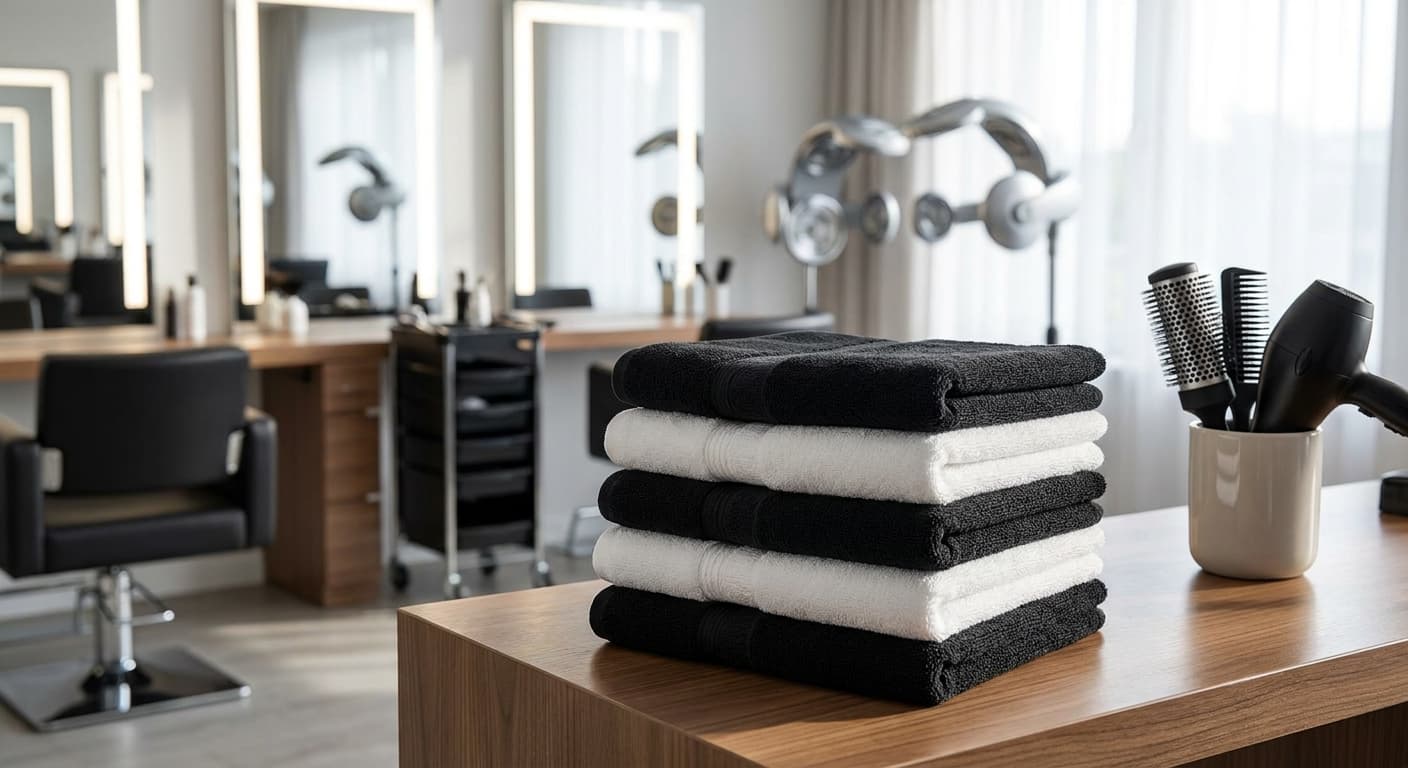
Color selection affects both aesthetics and maintenance costs. White towels remain the professional standard because they accept bleach sanitization and show true cleanliness to health inspectors. Bleach proof salon towels wholesale options ensure consistent appearance despite daily chemical exposure. Black towels hide dye stains and hair clippings but require careful washing to prevent fading. Some salons choose both: white for chemical services, black for cutting and styling.
Ordering quantities should account for growth projections and volume discounts. New salons often underestimate towel needs, creating operational stress during busy periods. Start with 100-150 towels minimum for a 4-6 chair salon, then expand inventory based on actual usage patterns. Professional suppliers with decades of wholesale experience help new salon owners calculate proper quantities. Consider wholesale bath towels for larger clients and wholesale beach towels for specialized services. Reliable suppliers ship within 2-3 business days, ensuring quick inventory replenishment when needed.