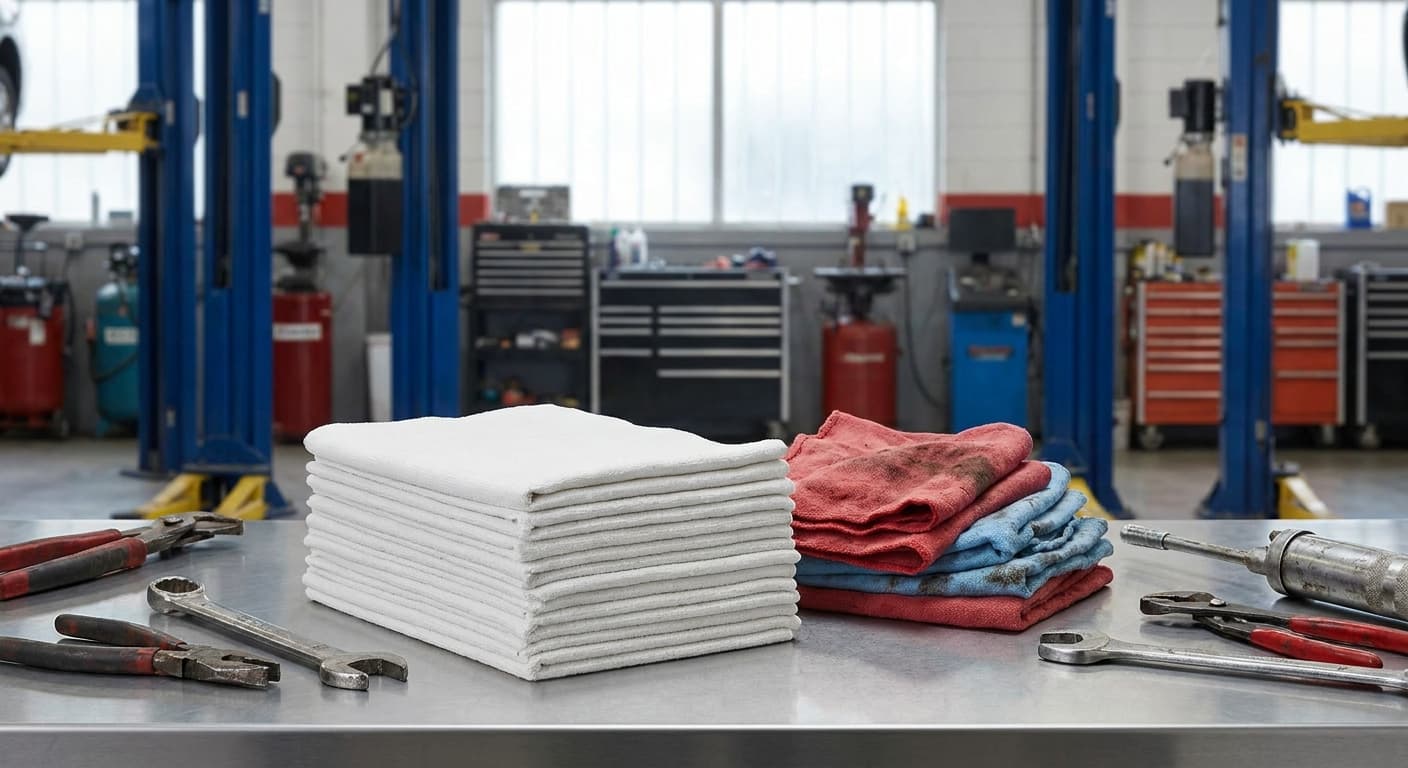

Professional Automotive Shop Rags: Complete Buyer's Guide
Professional automotive shops require specialized cleaning solutions that go beyond basic consumer products. The right automotive shop rags can mean the difference between efficient service delivery and costly delays, while poor choices lead to surface damage, safety incidents, and frequent replacement costs that eat into profit margins.
Professional automotive operations need commercial-grade shop rags rated for 200+ wash cycles, with 400-600 GSM microfiber for most applications and proper safety protocols for oily materials.
What safety precautions should I take when using shop towels around engine components?
Working around engine components requires strict safety protocols because shop towels often become saturated with flammable fluids. The primary concern involves heat sources that can ignite oil-soaked materials. Keep used shop rags at least three feet from exhaust manifolds, turbochargers, and catalytic converters, which can reach temperatures exceeding 1,200°F during normal operation.
Proper storage of contaminated shop rags prevents spontaneous combustion, a real risk when oils undergo oxidation in confined spaces. Store used rags in metal containers with tight-fitting lids, never in plastic bins or cloth hampers. The Occupational Safety and Health Administration requires these containers be emptied daily and cleaned regularly. For shops processing more than 20 vehicles daily, consider installing automatic sprinkler systems in storage areas.
Chemical compatibility matters when selecting wholesale shop rags for different applications. Synthetic materials resist breakdown from petroleum products better than cotton alternatives, extending usable life and reducing replacement frequency. Commercial-grade shop rags built for industrial use withstand exposure to brake cleaners, degreasers, and hydraulic fluids without deteriorating into lint that can clog filters or contaminate sensitive components. Towel Depot's automotive line features synthetic blends engineered for chemical resistance, maintaining integrity through 200+ wash cycles compared to retail alternatives that fail after 50-100 cycles.
How many microfiber towels do I need for a professional detailing operation?
Professional detailing operations require precise towel allocation based on service volume and vehicle types. A standard detail shop processing 15-20 vehicles daily needs approximately 60-80 microfiber towels in rotation. This accounts for dedicated towels for different tasks: 20 towels for washing, 15 for drying, 20 for interior work, and 15-25 for final polishing and wax application. Never use the same towel across different areas, as cross-contamination damages paint and interior surfaces.
Vehicle size significantly impacts towel requirements. Full-size trucks and SUVs consume 40% more towels than compact cars due to increased surface area. High-end detailing services that include engine bay cleaning and wheel well detailing need additional inventory. Factor in washing frequency when calculating total needs. Most professional operations wash towels every two days, meaning you need double your daily requirement to maintain continuous service while one set processes through the laundry cycle.
GSM weight determines performance and longevity in professional settings. Towel Depot's 400-600 GSM microfiber range provides the optimal balance of absorption and durability for most automotive applications. Lighter weights below 300 GSM work for glass and light dusting but lack the density needed for heavy cleaning tasks. Heavier towels above 700 GSM excel for water absorption during drying but become cumbersome for detailed work around trim pieces and small components. Professional buyers typically order in quantities of 100-500 units to secure volume discounts: 5% savings at 5 units, 10% at 10 units, and 15% savings at 15+ units.
What's the best method for removing adhesive residue without damaging surfaces?
Adhesive residue removal requires a systematic approach that matches the cleaning method to the surface material and adhesive type. Start with mechanical removal using plastic scrapers to eliminate bulk adhesive before applying solvents. This prevents solvents from spreading the adhesive over larger areas and reduces chemical usage. For painted surfaces, use citrus-based adhesive removers applied with low-pile microfiber towels that won't scratch clear coat finishes.
Temperature plays a crucial role in adhesive removal efficiency. Heat guns set to 200-250°F soften most automotive adhesives without damaging paint, making mechanical removal easier. Apply heat in short bursts rather than continuous exposure to prevent paint damage. Follow up with appropriate solvents applied using clean sections of your shop rag for each application. This prevents redepositing dissolved adhesive onto cleaned areas.
Different surfaces require specific approaches to prevent damage. Glass can tolerate stronger solvents and more aggressive mechanical action, while plastic trim pieces need gentle treatment to avoid crazing or discoloration. Vinyl surfaces resist most solvents but can be damaged by excessive heat. When working on multiple surface types, use dedicated shop rags for each material to prevent cross-contamination. Professional shops stock different towel types for various applications, with Towel Depot's automotive line offering specific solutions for different surface requirements. The key is understanding how to dispose of stain rags properly after use, as many solvents create hazardous waste that requires special handling.
How do I properly clean glass surfaces without leaving streaks or residue?
Streak-free glass cleaning depends on proper technique, quality materials, and environmental conditions. Professional results require a two-towel system: one damp towel for cleaning and one completely dry towel for final polishing. The cleaning towel should be barely damp, not soaking wet, as excess water creates the streaking that frustrates many technicians. Use distilled water mixed with automotive glass cleaner in a 50-50 ratio for optimal results.
Work in sections no larger than two square feet to prevent cleaning solution from drying before you can polish it away. Start at the top of the window and work downward in overlapping horizontal strokes. This prevents dirty water from dripping onto already cleaned areas. Follow immediately with the dry towel using circular motions, then finish with vertical strokes for a crystal-clear result.
Environmental factors significantly impact glass cleaning success. Never clean glass in direct sunlight or when surface temperatures exceed 80°F, as rapid evaporation causes streaking regardless of technique quality. High humidity helps by slowing evaporation, giving you more working time. Wind creates similar problems by accelerating moisture loss, so work on the leeward side of vehicles when possible. Commercial-grade microfiber towels with 400-500 GSM provide the right balance of absorbency and surface contact for professional glass work. Towel Depot's glass cleaning towels undergo special manufacturing processes that eliminate lint production, a common cause of visible residue on glass surfaces.
What's the best technique for cleaning delicate surfaces without causing scratches?
Delicate surface cleaning requires understanding surface hardness and appropriate pressure application. Piano black trim, soft plastics, and clear-coated surfaces scratch easily under improper cleaning techniques. Always start with the gentlest method and escalate gradually. Begin with compressed air to remove loose dirt and debris that could cause scratches during wiping. Follow with a pre-rinse using clean water to eliminate abrasive particles.
Microfiber selection becomes critical for delicate work. Ultra-fine microfiber towels with split fibers lift contaminants away from surfaces rather than dragging them across. Use the lightest possible pressure, letting the towel's texture do the work. When working on delicate surfaces, replace towels frequently as trapped particles can cause scratching even with proper technique. Professional detailers typically use fresh towel sections every few square feet on high-end vehicles.
The cleaning solution concentration must match the delicate nature of the surface. Dilute cleaners to 25% of normal strength for initial cleaning, increasing concentration only if necessary. Some surfaces require pH-neutral cleaners to prevent damage to protective coatings. Test cleaning products on inconspicuous areas before proceeding with visible surfaces. Professional shops maintain dedicated towel inventory for delicate work, storing them separately from general-use shop rags to prevent contamination. When learning how to clean oily rags and how to wash oily rags, remember that oil residue can transfer to delicate surfaces and cause permanent damage. Towel Depot's delicate surface line features ultra-fine 300-350 GSM microfiber specifically engineered for scratch-sensitive applications, with enhanced split-fiber technology that captures contaminants safely away from surface contact.