
Massage Therapy Towels: Commercial Buyer's Complete Guide
Massage therapy practices depend on professional-grade linens that perform consistently through hundreds of wash cycles while maintaining the comfort and hygiene standards clients expect. Whether you manage a day spa with 20 treatment rooms or a small wellness clinic with two massage therapists, your towel choices directly impact operational efficiency, client satisfaction, and bottom-line costs. Smart purchasing decisions made today determine your linen replacement costs and client experience quality for the next two years.
Commercial massage therapy towels require 400-600gsm weight, 100% cotton or cotton-poly blends, proper warming to 104-110°F, strategic draping techniques for client modesty, efficient room turnover protocols, and cost-per-use analysis that factors wash cycle durability over initial price.
How do you keep towels warm during massage treatments?
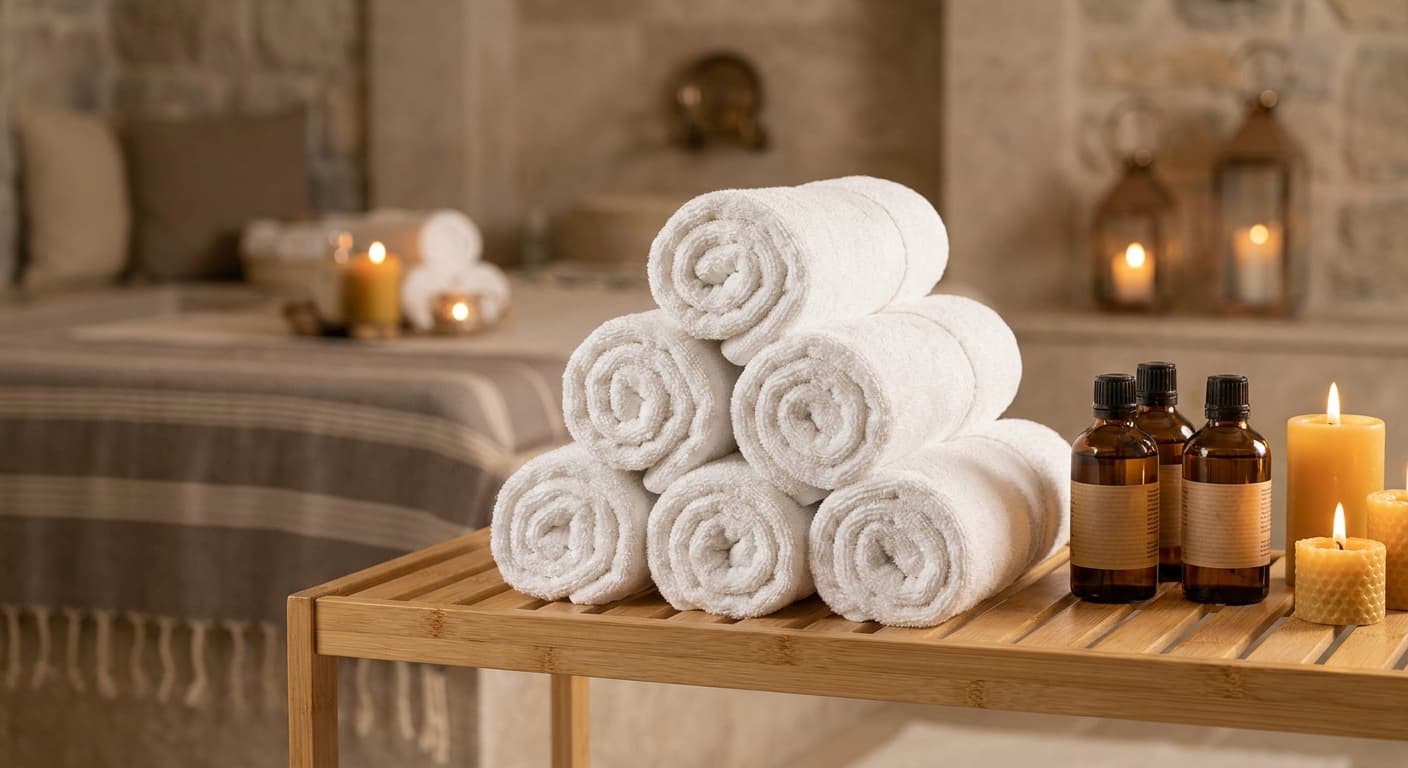
Professional massage practices maintain towel temperatures between 104-110°F for optimal client comfort without risking burns or excessive heat. Commercial towel warmers fall into two categories: UV sanitizing cabinets that heat while disinfecting ($800-2400 range) and simple heating cabinets ($200-600 range) that warm pre-sanitized linens. Most high-volume practices choose the sanitizing models since they handle both warming and final pathogen elimination in one step.
Energy costs for towel warming average $0.08-0.12 per treatment when factoring 15-20 minutes of heating time per session. Wholesale spa towels designed for commercial use retain heat longer than retail versions due to their higher GSM weight and tighter weave construction. A 500gsm commercial towel holds therapeutic warmth for 12-15 minutes compared to 6-8 minutes for typical retail towels, reducing the need for mid-treatment reheating.
Timing protocols matter for efficiency and safety. Load towels 20-25 minutes before client arrival to reach optimal temperature, and always test warmth on your inner wrist before client contact. Practices serving 6-8 clients daily typically need warming cabinet capacity for 24-32 towels to maintain seamless service without delays between appointments.
What are the proper draping techniques with towels for side-lying massage positions?
Side-lying massage positions require modified draping that maintains client modesty while providing therapist access to treatment areas. The foundation involves one large bath towel (30" x 56" minimum) positioned lengthwise along the client's torso, with a second towel draped over the top leg and hip area. Professional massage therapists typically use three towels total for side-lying work: one for torso coverage, one for the upper leg, and one for working areas that need temporary exposure.
The key technique involves tucking the primary towel securely along the client's back and front torso, creating a stable foundation that won't shift during treatment. The secondary towel covers from hip to knee on the upper leg, secured with a slight tuck near the hip. When working on specific areas like the IT band or glutes, therapists lift only the necessary towel section while maintaining coverage of adjacent areas. This method requires towels with sufficient size and weight to drape properly without constant readjustment.
Commercial-grade spa towels in the 450-500gsm range provide ideal draping characteristics for side-lying positions. Lighter towels tend to slip and require frequent repositioning, while towels over 600gsm can feel too heavy and warm for extended side-lying work. Cotton towels offer better grip and stay-put properties compared to cotton-poly blends, making them the preferred choice for practices that frequently use side-lying techniques.
How do you efficiently prep massage rooms with clean linens between clients?
Efficient room turnover depends on standardized linen quantities and systematic preparation protocols. Most commercial massage practices allocate 15-20 minutes between clients for complete room reset, with linen changeover taking 3-4 minutes of that window. The standard linen set includes two bath towels, one face cradle cover, one fitted sheet, one flat sheet, and one blanket, with backup towels staged nearby for treatments requiring additional draping.
Successful practices pre-stage clean linen sets in rolling carts or designated storage areas adjacent to treatment rooms. Each therapist receives 4-5 complete linen sets at shift start, enough for a full day without mid-shift restocking. Soiled linens go directly into designated hampers with antimicrobial liners, never touching clean surfaces or storage areas. This separation prevents cross-contamination and maintains the hygiene standards required for professional massage environments.
Volume planning requires calculating 3-4 complete linen sets per treatment room per day, plus 20% buffer for unexpected needs like early arrivals or extended treatments. A four-room spa needs 12-16 complete sets daily, translating to 24-32 wholesale bath towels, 12-16 fitted sheets, and corresponding face cradle covers. Practices operating near capacity often invest in commercial washers to process linens overnight rather than outsourcing to laundry services.
What GSM weight and fabric composition deliver the best performance for massage therapy towels in high-volume commercial settings?
Commercial massage therapy environments require towels in the 400-600gsm range for optimal performance across durability, absorbency, and client comfort factors. Towels below 400gsm feel thin and cheap to clients while wearing out after 100-150 wash cycles. Towels above 600gsm take longer to dry, increase laundry costs, and can feel too heavy during treatments. The sweet spot for most commercial applications falls between 450-550gsm, providing professional feel with 200-300 wash cycle durability.
Fabric composition significantly impacts performance in commercial settings. 100% cotton towels offer superior absorbency and softness but require careful washing to prevent excessive shrinkage. Cotton-poly blends (typically 80/20 or 70/30 ratios) provide better shape retention and faster drying times while maintaining good absorbency. Many high-volume practices prefer cotton-poly blends because they reduce labor costs and maintain consistent sizing through hundreds of wash cycles.
Ring-spun cotton construction outperforms standard cotton in both durability and client comfort. Ring-spun fibers create stronger, smoother towels that resist pilling and maintain absorbency longer than standard cotton alternatives. Commercial towels should feature double-turned hems and reinforced edges to withstand industrial washing equipment and high-temperature sanitizing cycles. Towel Depot's commercial-grade options range from 300-900gsm, with 59 years of experience helping massage practices identify the optimal specifications for their specific volume and budget requirements.
How should spa and salon managers calculate the true cost per use when comparing bulk massage towel suppliers?
True cost per use analysis requires factoring initial price, expected wash cycles, replacement frequency, and volume discounts into a comprehensive calculation. A $12 commercial towel lasting 250 wash cycles costs $0.048 per use, while a $8 retail-grade towel lasting 100 cycles costs $0.08 per use. The cheaper upfront option actually costs 67% more over its useful life. Smart purchasing managers focus on cost per use rather than initial price when evaluating suppliers for commercial applications.
Volume discounts significantly impact long-term costs for practices willing to order appropriate quantities. Standard volume breaks typically offer 5% discounts at 5+ units, 10% at 10+ units, and 15% at 15+ units. A massage practice needing 40 towels annually saves $72-96 by placing one bulk order instead of multiple small orders throughout the year. Practices with storage space often order 6-month supplies to capture maximum volume discounts while ensuring consistent linen quality.
Additional cost factors include shipping, inventory carrying costs, and replacement timing. Suppliers offering 2-3 business day shipping reduce the inventory buffer needed for emergency replacement orders. Practices can safely operate with 90-day linen supplies when working with reliable suppliers, compared to 120-180 day supplies needed when using slower or less reliable vendors. Calculate total annual linen costs including shipping, storage, and opportunity costs to identify the most economical supplier relationships for your specific volume and timing requirements.