
How Often Should Salons Wash Towels? Schedule & Tips
In this guide:
- Why Daily Washing Is the Industry Standard
- The Science of Towel Contamination
- Calculating Your Towel Inventory
- Optimal Washing Practices
- Cost Analysis: Daily Washing vs. Linen Service vs. Replacement
- Frequently Asked Questions
Every B2B buyer from salon owners to hotel housekeeping managers faces the same question: how often should you wash your towels? The answer affects your hygiene, your towel lifespan, and your bottom line. With sixty years in the linen industry, Towel Depot knows the proven schedule and tips that keep your inventory working for you.
Wash towels after every single use. For high volume operations that means daily washing or twice daily. Skipping washes costs you money in towel replacement and client trust.
Why Daily Washing Is the Industry Standard
Salon towels absorb more than water. They pick up hair dye, bleach, perm solution, chemical relaxers, shampoo residue, and body oils. They also pick up microscopic skin cells and bacteria from every client. After eight to ten uses the fibers are saturated. If you let those towels sit in a hamper overnight, mildew starts growing within hours. Odor sets in fast. You are not just washing dirt. You are fighting biology.
Daily washing is non negotiable for a reason. The CDC recommends frequent laundering of all reusable textiles in commercial settings. For salons, state health regulations often require clean towels for each client. Failure to meet those standards can lead to fines or even closure. Daily washing kills bacteria and mold before they spread. It keeps your towels looking white and feeling soft.
A daily wash schedule also extends the life of your towels by three to four times compared to weekly washing. The constant buildup of oils and chemicals weakens cotton fibers. Washing every day removes those contaminants while they are fresh. Fibers stay intact. GSM ratings hold. Your towels last longer and you spend less on replacements. That directly helps your operating budget.
The Science of Towel Contamination
Think about everything a towel touches during a single salon visit. Wet hair, styling products, chemical treatments, and the client's skin. Each contact leaves behind organic matter. That matter includes bacteria like staphylococcus and pseudomonas. In a warm, damp towel those bacteria multiply rapidly. The OSHA bloodborne pathogens standard applies to salons that handle cuts or nicks during services. Used towels can carry blood or other bodily fluids.
Mildew and mold thrive in towels left unwashed for more than twelve hours. A recent study found that 90 percent of used barber towels contained coliform bacteria after 24 hours. The numbers go up fast. By day two the towel is a health hazard. Even if it smells fine, the germs are there. High volume salons with twenty or more clients per day generate enough contaminated towels to fill a large hamper within hours. Two wash cycles per day are needed to keep the pile from building up.
For spas and gyms the risk is even higher. Towels used for hot towels or steam treatments hold moisture longer. Bacteria love that environment. A single dirty towel left in a bin overnight can contaminate the whole batch. That is why you must wash all towels at a minimum temperature of 140°F (60°C). Hot water breaks down oils and kills pathogens. Detergent alone is not enough. Heat and agitation are your best defense.
Calculating Your Towel Inventory
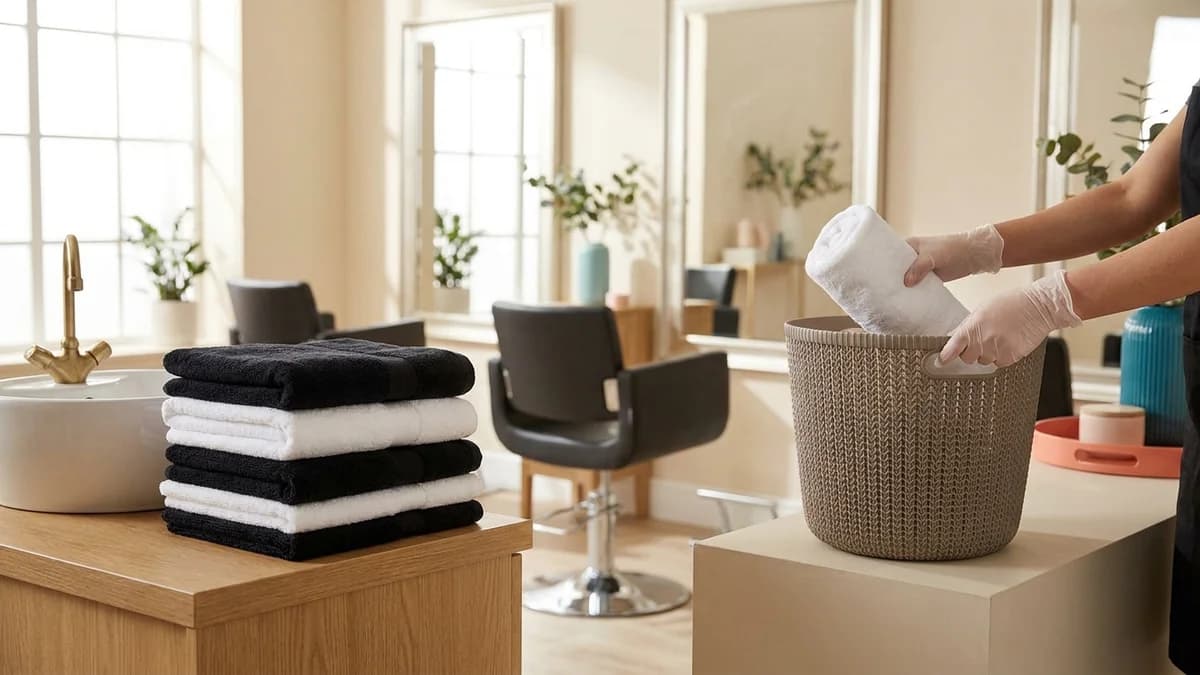
You cannot wash daily unless you have enough towels to rotate. The math is simple. You need three batches. One batch is being used by clients. One batch is in the wash or drying. One batch is on the shelf ready to go. For most salons that means a minimum of 150 to 200 towels. If you run a high volume operation with ten or more stations, you need 250 to 300 towels. This number assumes standard size salon towels of 400 to 600 GSM.
Many buyers underestimate how many towels they actually need. They buy 80 towels and try to make it work. That forces them to wash twice a day or reuse damp towels. Reusing damp towels defeats the purpose of washing. Damp towels breed bacteria within the folds. Clients can feel the dampness and smell the mildew. It damages your reputation. When you buy wholesale bath towels from Towel Depot you get consistent sizes and GSM weights that hold up to daily washing.
A good rule of thumb is one dozen towels per station per day. Then multiply by three for the rotation. If you have eight stations you need 24 dozen towels. That is 288 towels. That number sounds high but it is the only way to maintain a clean dry towel for every client. Without that buffer you will constantly run short. You will end up washing only half loads or skipping washes altogether. Both options are bad for your business.
Optimal Washing Practices
The wash cycle matters as much as the schedule. Start with a cold rinse to remove loose debris and dyes. Then run a hot wash at 140°F (60°C) minimum. For white towels you can go to 160°F (71°C). Use a heavy duty detergent that contains enzymes. Enzymes break down protein stains from hair and skin. Avoid fabric softener. Softener coats the fibers and reduces absorbency. Your towels need to absorb water, not repel it.
For sanitization add a commercial sanitizer approved by the EPA Safer Choice program. Chlorine bleach works on white towels but it weakens cotton over time. Limit bleach to every third wash. For colored towels use oxygen bleach or a hydrogen peroxide based sanitizer. Wash towels in full loads to maximize mechanical action. Overloading a washer reduces cleaning efficiency. Undersized loads waste water and energy.
Drying is just as important. Dry towels on high heat until they are completely bone dry. Do not remove them while still damp. Damp towels invite mold. Tumble dry on high for about 40 to 50 minutes depending on GSM weight. A 500 GSM towel needs longer than a 300 GSM towel. Always shake out towels before you fold them. This prevents lint from building up in the fold lines. Lint traps bacteria and creates clumps.
Cost Analysis: Daily Washing vs. Linen Service vs. Replacement
Many buyers assume daily washing is expensive. The numbers tell a different story. Washing a load of towels at home or in a small commercial machine costs roughly $0.50 per load. That includes water, detergent, and energy. If you wash one load per day, your monthly laundry cost is about $15. Compare that to replacing a set of mildewed towels every 12 to 18 months. A set of 150 towels costs $400 to $600. Daily washing pays for itself within the first year.
Linen service is an alternative. A professional linen company picks up dirty towels and drops off clean ones. The cost ranges from $0.30 to $0.80 per towel depending on volume and location. For a salon using 150 towels per day that is $45 to $120 per day. Over a month that is $1,350 to $3,600. Linen service makes sense if you have no laundry space or staff. But it is not cheaper than washing yourself. For most B2B buyers, owning your towels and washing daily gives you more control and lower long term costs.
Replacement costs hit when you cut corners. If you wash towels less often, they wear out faster. Mildew eats the cotton. Chemical residue builds up and stiffens the fabric. A towel that should last 500 washes might only last 150 washes. That means you replace your entire inventory every six months. The math is brutal. Buy good towels from a supplier like Towel Depot. Our wholesale hotel towels and wholesale beach towels are built for commercial laundry cycles. But even the best towel fails without a proper washing routine.