
How Do Cooling Towels Work
In this guide:
- What makes cooling towels work?
- How long do cooling towels stay cool?
- Are cooling towels durable for commercial laundry?
- What sizes and GSM should a business buy?
- How do cooling towels compare to other cooling methods?
- FAQs on cooling towels
Cooling towels are a practical investment for hotels, salons, spas, gyms, and restaurants that need to keep staff and guests comfortable in hot environments. These towels lower skin temperature through evaporative cooling without electricity or chemicals. For B2B buyers placing bulk orders of 100 to 500 units, understanding how they work helps you choose the right product for your commercial setting.
Cooling towels use evaporative cooling to drop skin temperature by 15 to 30 degrees Fahrenheit (9 to 17 degrees Celsius). They stay cool for 30 minutes to 3 hours depending on conditions and can survive 500 or more commercial wash cycles. A good quality towel costs 3 to 5 dollars per unit and replaces disposable cooling methods.
What makes cooling towels work?
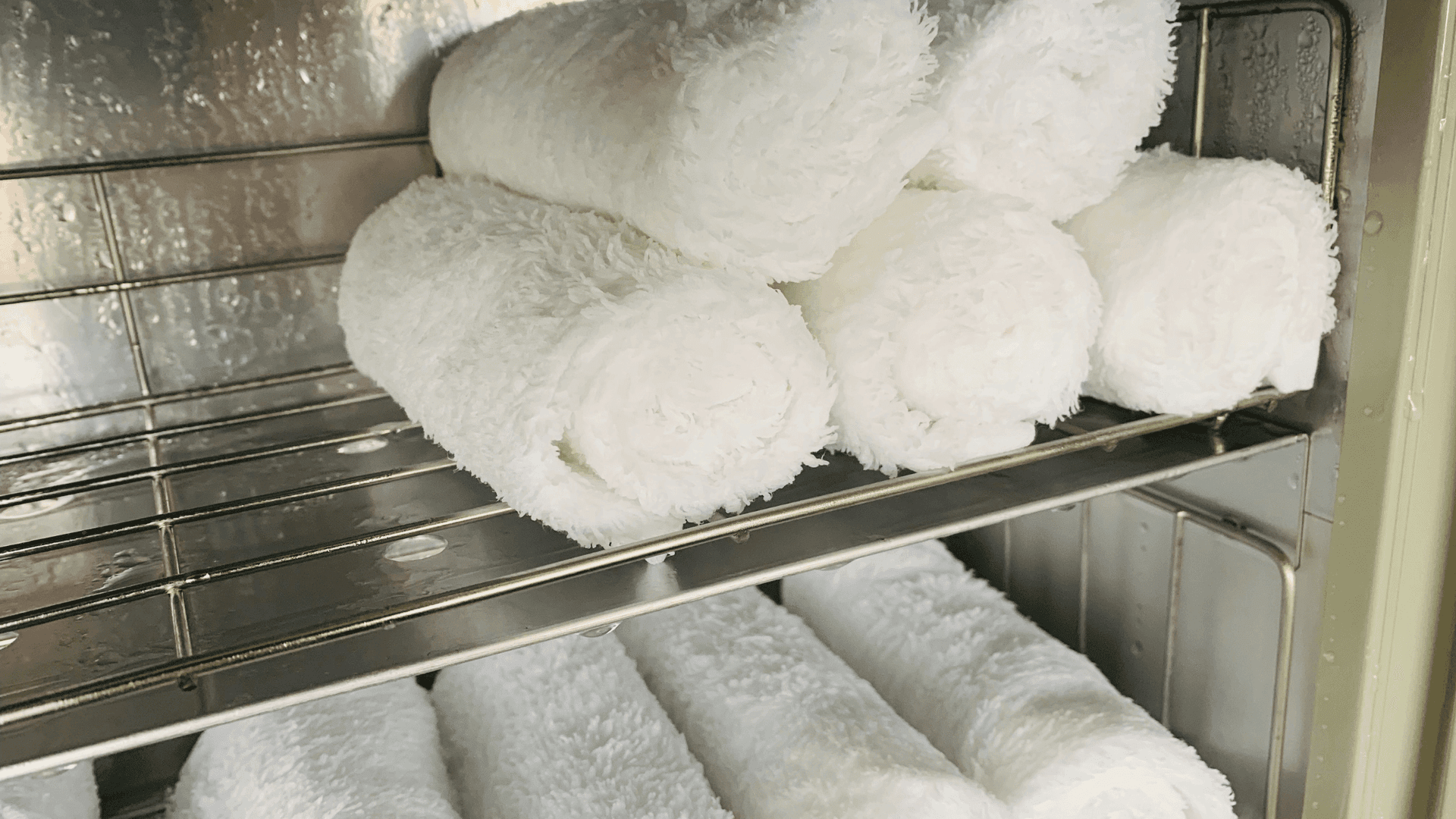
Cooling towels rely on evaporative cooling, a process every commercial buyer should understand before ordering. When you wet the towel and wring out excess water, the fabric holds moisture in its fibers. As air passes over the towel, water molecules change from liquid to gas. That phase change pulls heat energy from the surface of the fabric and from your skin. The result is a temperature drop that can range from 15 degrees Fahrenheit (9 degrees Celsius) to 30 degrees Fahrenheit (17 degrees Celsius) below the ambient air temperature, depending on conditions like humidity and airflow.
The fabric choice matters more than you might think. Polyvinyl alcohol (PVA) and high gauge microfiber are the two most common materials for cooling towels. PVA towels absorb up to 10 times their weight in water and release it slowly over time. Microfiber towels with a GSM between 220 and 280 also work well because the fine fibers create a large surface area for evaporation. Lower GSM towels around 150 dry out too fast for sustained cooling. Higher GSM towels above 320 retain too much water and become heavy and uncomfortable for neck or shoulder use.
The Occupational Safety and Health Administration (OSHA) recommends evaporative cooling products for outdoor workers as part of a heat illness prevention program. You can read their guidance at osha.gov/heat. For indoor commercial spaces like kitchens, laundry rooms, or fitness centers, cooling towels provide a mobile solution that doesn't require fixed equipment or electrical outlets. This makes them easy to deploy across multiple workstations or guest areas.
How long do cooling towels stay cool?
Cooling time varies directly with air flow, humidity, and fabric saturation. In a dry gym environment with 30 percent humidity and a fan blowing, a quality cooling towel can remain effective for 2 to 3 hours. In a humid restaurant kitchen at 70 percent humidity, the same towel may stay cool for only 30 to 45 minutes. The reason is simple: when the air is already saturated with moisture, water on the towel evaporates much more slowly. You can reactivate the towel by rewetting it, which takes about 10 seconds under a faucet.
Ambient temperature also affects duration. At 90 degrees Fahrenheit (32 degrees Celsius) with low humidity, the temperature drop can reach 30 degrees Fahrenheit (17 degrees Celsius). At 100 degrees Fahrenheit (38 degrees Celsius), the drop narrows to about 20 degrees Fahrenheit (11 degrees Celsius) because the rate of evaporation increases but the cooling effect is offset by higher ambient heat. The Centers for Disease Control and Prevention (CDC) provides heat stress tables that show how evaporative cooling effectiveness changes with conditions. Their resources at cdc.gov/niosh/topics/heatstress are worth reviewing when you choose cooling products for your facility.
For commercial buyers, this means you need to match the towel to the environment. In a dry spa or salon, a single application may cover an entire treatment. In a high humidity restaurant kitchen, you should plan for a rewetting station or provide two towels per shift. Laboratory tests from textile institutes show that microfiber cooling towels maintain 80 percent of their initial cooling capacity after 10 reactivations in a single day. That performance makes them reliable for back of house staff who need consistent relief throughout a shift.
Are cooling towels durable for commercial laundry?
Durability is a critical factor when you order 100 to 500 units for repeated use. High quality cooling towels made from PVA or microfiber can withstand 500 or more commercial wash cycles before showing signs of edge fraying or loss of absorbency. The key is the fabric construction. Look for towels with a GSM of 200 to 300 and tight weave that resists pilling. Cheaper towels below 180 GSM often lose their shape after 50 washes and become too thin to hold enough water for effective cooling.
Wash temperature matters. Cooling towels should be laundered in cool water, between 70 and 90 degrees Fahrenheit (21 to 32 degrees Celsius). Hot water above 140 degrees Fahrenheit (60 degrees Celsius) can damage the polymer structure of PVA fibers. Never use fabric softeners or dryer sheets. These products leave a waxy coating that blocks water absorption and cuts cooling performance by 40 to 60 percent after just a few washes. The Association for Linen Management and other industry bodies have published best practices for microfiber care. The ISSA Cleaning Management Institute offers guidelines at issa.com/education/certifications/cmi-textile-care that apply directly to cooling towel maintenance.
Tumble drying on low heat for 20 minutes is acceptable. High heat can shrink microfiber towels and reduce GSM by 10 to 15 percent. Air drying is better. If you run a hotel or gym with an established laundry operation, cooling towels can be added to the same low temperature cycle used for wholesale hotel towels. Just separate them from terry cloth to avoid lint transfer, and skip the bleach. A properly cared for cooling towel will last through at least two years of daily use in a commercial setting.
What sizes and GSM should a business buy?
The most common size for commercial cooling towels is 12 by 30 inches. This size wraps easily around the neck or can be draped over the shoulders. For full body cooling, such as in a spa after a hot treatment or in a gym after a workout, 24 by 48 inch towels work better. They cover more surface area and provide a broader cooling zone. When ordering for a salon or spa, neck size towels are usually sufficient and easier to launder. Kitchens and warehouses often prefer the larger size for wrapping around the torso.
GSM, or grams per square meter, is the fabric weight. For cooling towels, the sweet spot is 220 to 280 GSM. Towels at 220 GSM hold enough water for about 45 minutes of active cooling without feeling heavy. Towels at 280 GSM last closer to 90 minutes but weigh about 25 percent more when wet. That extra weight can be a problem for workers who move around frequently. Test both weights with a sample order of 10 units before committing to 500. Many suppliers, including Towel Depot, offer sample packs for commercial buyers.
Bulk pricing typically breaks down by GSM and size. A 12 by 30 inch towel at 250 GSM costs between 3 and 5 dollars per unit in orders of 100 to 500. The same towel in 220 GSM costs about 10 percent less. For comparison, a standard wholesale bath towel of similar size in terry cloth runs 4 to 8 dollars, but it doesn't provide cooling. The investment pays back quickly when you consider that a cooling towel replaces multiple disposable cooling packs per day. A single pack costs 1 to 2 dollars and lasts one use. Over a 90 day summer season, that adds up to 90 to 180 dollars per worker. A reusable cooling towel at 4 dollars per unit covers the same period with zero per use cost after the initial purchase.
How do cooling towels compare to other cooling methods?
Cooling towels beat most alternatives on cost, safety, and ease of use. Misting fans require a water source and electricity. They can cost 200 to 500 dollars per unit and need maintenance. They also create wet floors, which are a slip hazard in restaurants and spas. Ice packs are single use or need freezer space and recharging. A case of 100 disposable ice packs costs around 60 dollars and generates waste. Cooling towels need only a faucet and a spin cycle to be ready again. They produce no waste and no puddles.
Air conditioning is the gold standard for cooling, but it is expensive to run. A commercial HVAC system in a 2,000 square foot space costs 0.10 to 0.25 dollars per square foot per hour to operate. In a kitchen or gym where temperatures already run high, cooling towels reduce reliance on air conditioning by providing personal cooling directly to workers. Studies from the National Institute for Occupational Safety and Health show that personal cooling garments can lower core body temperature by 1 to 2 degrees Fahrenheit (0.5 to 1.1 degrees Celsius) over a 30 minute period. That drop is enough to prevent heat cramps and reduce fatigue.
For outdoor use, like poolside hotel service or beach club operations, cooling towels work as well as any portable fan and better than shade alone. Towel Depot's wholesale beach towels are popular for resort use, and adding cooling towels to the mix gives guests an extra layer of comfort. From a buyer's perspective, cooling towels require no training to use, no batteries to replace, and no special storage. They fold flat for inventory and take up minimal shelf space. For a commercial operation that values uptime and worker safety, they are the simplest solution on the market.