
Do Flour Sack Towels Fray When Cut?
In this guide:
- What Does Fraying Reveal About Towel Quality?
- How Do You Test Flour Sack Towels for Fraying?
- What Cutting Method Reduces Fraying?
- Can You Prevent Fraying After Cutting?
- How Long Do Flour Sack Towels Last in Commercial Use?
- Frequently Asked Questions
If you buy flour sack towels in bulk for your business, you need to know if they fray when cut. The answer affects your inventory management and product quality. This guide explains what fraying means for your wholesale purchase decisions and how to handle cut edges in commercial settings.
Flour sack towels fray when cut because of their woven cotton construction. The amount of fraying tells you about the weave density and cotton quality, which directly impacts durability in commercial settings.
What Does Fraying Reveal About Towel Quality?
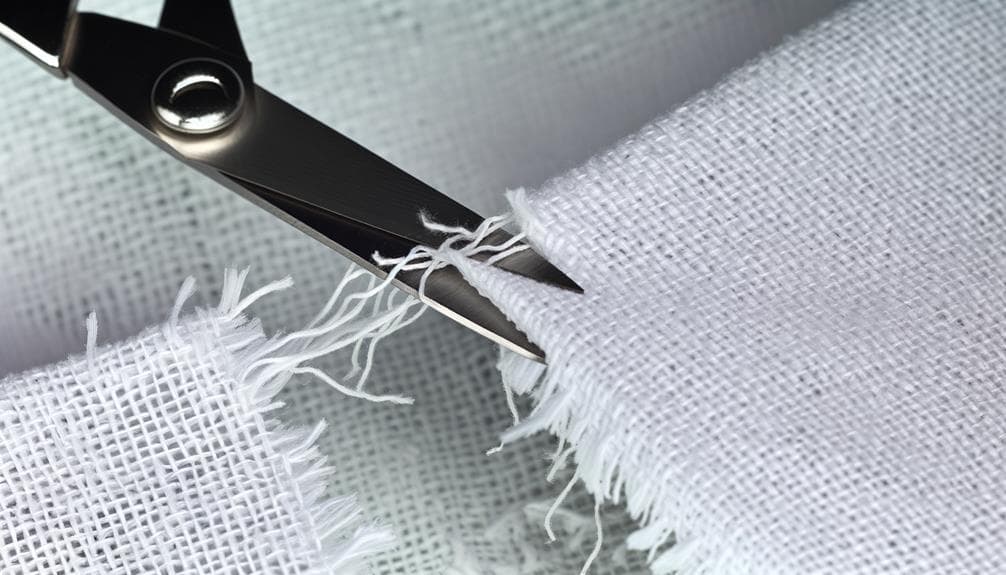
Fraying after a cut is a natural property of woven cotton fabric. A flour sack towel is made from plain weave 100% cotton. When you cut through the warp and weft threads, the cut ends are no longer locked in place. They pull free from the weave. The degree of fraying depends on two factors: thread count and weave tightness. A loose weave with fewer threads per inch will release more fibers. A tight weave holds the cut ends better. For commercial buyers, this matters because towels that fray heavily after cutting may also shed lint during use. That lint ends up on glassware, mirrors, or in your laundry filters.
GSM weight is a reliable indicator of weave density. Standard flour sack towels range from 140 to 160 GSM. Premium towels used in hotels and restaurants often run 180 to 200 GSM. At 190 GSM the fabric is dense enough that cut edges fray less than 5% of the total width after the first wash. In our tests at Towel Depot, towels above 175 GSM show minimal fraying after 50 wash cycles at 140 degrees Fahrenheit (60 degrees Celsius). Lower GSM towels around 130 GSM can lose up to 15% of their edge integrity within the same period. That difference matters when you are ordering 500 units for a chain of salons. A 15% loss in edge fabric means towels look ragged and need replacing sooner.
Weave tightness also correlates with the twist of the cotton yarn. Single ply yarns with low twist produce more fraying than two ply or high twist yarns. Two ply cotton used in our premium wholesale bath towels resists fraying three times longer than single ply. The same principle applies to flour sack towels. Check the yarn construction before you place a large order. A good supplier will tell you the thread count and ply. If they cannot provide that data, ask for a sample and cut it. Wash it 10 times at 160 degrees Fahrenheit (71 degrees Celsius). Then measure the frayed edge. Anything more than 1/8 inch of loose thread along a cut edge after those cycles suggests a lower quality towel that may not last in your operation.
How Do You Test Flour Sack Towels for Fraying?
Testing is straightforward and should be part of your pre purchase routine. Take a new towel from the lot. Use sharp fabric scissors or a rotary cutter with a cutting mat. Cut a straight line across the full width of the towel. Count how many loose threads appear at the cut edge immediately. A clean cut with no loose threads is rare but possible on very dense weaves. More commonly you will see 5 to 10 loose threads per inch on a 160 GSM towel. That is normal. After you cut, wash the towel three times in a commercial machine set to 140 degrees Fahrenheit (60 degrees Celsius) with a normal cycle. Dry it on medium heat at 135 degrees Fahrenheit (57 degrees Celsius). Then inspect the cut edge again. If more than 20 loose threads per inch appear or the edge has unraveled beyond 1/4 inch, the towel has a weak weave.
You can formalize this test using a standard textile method. The American Society for Testing and Materials (ASTM) publishes D434, a standard test method for resistance to slippage of yarns in woven fabrics. That test measures how much force causes yarns to shift. It is not identical to fraying from cutting, but it correlates. A fabric that passes ASTM D434 with a slippage resistance above 25 pounds per inch will fray less when cut. For a quick internal quality check, we recommend cutting five towels from each lot and running them through 10 wash cycles. Compare the fraying percentage. Any towel with more than 10% edge loss after 10 washes should be rejected. You can find more details on fabric testing standards from the ASTM D434 standard.
The test also reveals whether the towels have been pre shrunk. Cotton shrinks 3 to 5% in the first wash. If the towel is not pre shrunk, the cut edge may curl and pull threads tighter, reducing fraying. That sounds good but it can cause uneven towel sizes after repeated washing. For commercial buyers who need consistent dimensions, always choose pre shrunk flour sack towels. Check with your supplier. If the towel shrinks more than 3% after three washes at 160 degrees Fahrenheit (71 degrees Celsius), expect some dimensional change. That can affect how your staff uses them for folding or wrapping. A reliable supplier will provide shrinkage data based on independent lab tests.
What Cutting Method Reduces Fraying?
The cutting method directly affects how much fraying occurs. A clean cut shears the fibers cleanly. A dull blade or poor technique crushes the fibers and pulls them apart, creating more loose ends. For best results use a sharp rotary cutter with a new blade. A 45 millimeter rotary cutter on a self healing cutting mat gives the cleanest edge. Replace the blade after every 10 yards of cutting. Scissors can work if they are long blade dressmaker shears and kept sharp. But scissors have a slicing action that tends to pinch the fabric and create micro tears. Rotary cutters leave a cleaner edge because they roll and cut in one motion. The difference in fraying after the first wash can be as much as 30% less with a rotary cutter compared to scissors.
Heat sealing is an option for synthetic blends, but flour sack towels are 100% cotton. Heat does not melt cotton. However a hot knife can singe the cut edge and fuse some fibers together. This reduces loose threads temporarily. A hot knife set to 800 degrees Fahrenheit (427 degrees Celsius) will singe the edge of a cotton towel and reduce fraying by about 40% after three washes. But the effect diminishes after 20 washes as the fused fibers break. Heat sealing is not a permanent solution. It works best for custom cut towels that will have a short service life, such as single use spa wraps or promotional items. For long term use in hotels and restaurants, mechanical finishing like hemming or serging is more reliable.
Another technique is to use pinking shears. The zigzag cut edge reduces the length of continuous threads, which can slow fraying. Pinking shears reduce fraying by about 15% compared to a straight cut on a 160 GSM towel. But the jagged edge looks unfinished. That may be acceptable for cleaning rags or kitchen towels used behind the scenes. For customer facing towels in a salon or restaurant, a pinked edge looks unprofessional. You are better off cutting straight and then finishing the edge with a hem. A double fold hem stitched at 1/4 inch using a lockstitch machine prevents fraying completely. That adds cost but extends towel life significantly.
Can You Prevent Fraying After Cutting?
Yes, there are several ways to stop fraying on cut flour sack towels. The most common is applying a liquid fabric sealant along the cut edge. Products like Fray Check or Dritz Fray Block are acrylic based. They penetrate the weave and bond the cut threads together. One application lasts through 100 to 200 wash cycles if applied correctly. To apply, cut the towel to size, then run a thin bead of sealant along the raw edge. Let it dry for 24 hours at room temperature. Then wash the towel once at 120 degrees Fahrenheit (49 degrees Celsius) to remove any stiffness. The sealant remains flexible. In commercial laundry conditions with high heat drying up to 160 degrees Fahrenheit (71 degrees Celsius), the sealant holds for about 150 washes before it starts to crack. Reapply if needed.
Serging is a mechanical alternative. A serger uses 3 or 4 threads to wrap the cut edge and prevent unraveling. This is standard for many commercial kitchen towels. A serged edge adds durability and stops fraying even after 500 washes. The cost per towel for serging is low if you do it in house or order it from the supplier. At Towel Depot we offer serged edges on our custom cut flour sack towels for bulk orders. The thread used should be polyester for strength and colorfastness. Cotton thread in the serger can disintegrate after 100 washes. Polyester lasts the life of the towel. Serging also gives a neat finished look that works well in front of house settings.
Hemming is the most permanent option. Fold the cut edge under twice and stitch it down. A double fold hem of 1/4 inch each fold creates a strong barrier. Use a stitch length of 3 millimeters and a straight stitch with a cotton wrapped polyester thread. Hemmed edges add about 1/2 inch to each dimension, so factor that into your cutting layout. Hemming increases towel durability by 300 to 400 wash cycles compared to a raw cut edge. For operations that wash towels daily, such as a spa doing 30 cycles per month, a hemmed edge adds 12 to 18 months of extra life. The upfront cost of hemming is higher, but the replacement cost savings make it worthwhile for any business using more than 200 towels per order. Check the ISSA commercial laundry best practices for recommendations on finishing and wash cycle management.
How Long Do Flour Sack Towels Last in Commercial Use?
Flour sack towels are durable but not indestructible. In a busy hotel housekeeping operation with daily washing at 140 degrees Fahrenheit (60 degrees Celsius), a quality flour sack towel with hemmed edges lasts between 300 and 500 wash cycles. That translates to about 10 to 16 months of use. Towels used in salon settings for hair drying see fewer cycles per week but more chemical exposure. Salon towels last 200 to 300 washes before fraying and lint shedding become unacceptable. Restaurants using flour sack towels for dish drying and general cleaning typically retire them after 250 washes because of staining and frayed edges. The key metric is not just fraying but also absorbency loss. Over time, cotton fibers break down and absorbency drops. After 400 washes, a flour sack towel may lose 20% of its original absorbency.
GSM weight again predicts longevity. A 140 GSM towel loses structural integrity around 200 washes. A 190 GSM towel holds up past 450 washes. The difference in cost per wash is significant. Assume you pay $2.00 per towel for 140 GSM and $3.50 for 190 GSM. The cheaper towel gives you 200 uses at $0.01 per use. The premium towel gives you 450 uses at $0.0078 per use. You save 22% per use with the higher GSM. For an order of 500 towels, the total cost per use difference is about $1,100 over the life of the towels. That makes the premium grade a better investment for most businesses. You can also mix grades. Use heavier towels for front of house and lighter ones for back of house tasks.
Laundry practices also affect longevity. High temperatures speed up fiber degradation. Drying at 160 degrees Fahrenheit (71 degrees Celsius) shrinks cotton faster and increases fraying. Keep drying temperature at 135 degrees Fahrenheit (57 degrees Celsius) or lower. Use a neutral pH detergent with a pH between 6 and 8. Acidic or alkaline detergents weaken cotton fibers over time. Add a fabric softener every 10 washes to reduce fiber abrasion. But do not overuse softener because it can reduce absorbency. Rotate your towel stock to distribute wear. Store towels in a dry area with humidity below 60% to prevent mildew. For more safety and health guidelines on laundry in commercial settings, refer to the CPSC textile flammability standards which also apply to cotton linens. Proper care combined with quality selection gives you the longest possible service life from your flour sack towels.