
Disinfectant Wipe Specifications for Businesses
In this guide:
- Surface Compatibility
- Kill Claims and EPA Registration
- Contact Time Requirements
- Storage and Shelf Life
- Disposal and Environmental Impact
- Frequently Asked Questions
Buying disinfectant wipes in bulk for your hotel, salon, or gym means you need more than just a low price. You need wipes that work on the surfaces you clean, kill the pathogens you worry about, and stay wet until the last wipe is used. This guide covers the key specifications every wholesale buyer should know before placing an order for 100 to 500 units.
Disinfectant wipes must be matched to your surfaces, your required kill claims, and your storage conditions. Contact time, active ingredient concentration, and proper disposal matter more than brand name.
Surface Compatibility
Not all disinfectant wipes are safe for every surface. A wipe meant for stainless steel countertops may ruin a polished wood reception desk or a fabric salon chair. The label on each canister lists compatible materials. You must read that list before you clean. Otherwise you risk costly damage and voided warranties.
For example, wipes containing high concentrations of alcohol (60% to 70% isopropyl or ethanol) can strip finishes on lacquered wood and weaken certain plastics. Quaternary ammonium compounds (quats) are gentler on metal and glass but can leave a residue on mirrors and windows. Hydrogen peroxide based wipes are effective on hard nonporous surfaces like bathroom tiles and granite, but they can bleach colored grout and fabrics. Always test a wipe on a small hidden area first.
In a hotel housekeeping setting, you might need different wipes for guest bathroom countertops, gym equipment, and restaurant dining tables. A single wipe type rarely works for all three. Consider stocking two or three formulations. Your wholesale bath towels supplier can often recommend a wipe that pairs well with the textiles you already use. Check with your distributor about compatibility with common surfaces in your facility: stainless steel, laminate, glass, painted drywall, and sealed stone.
Kill Claims and EPA Registration
Every disinfectant wipe sold in the United States must be registered with the Environmental Protection Agency (EPA). The EPA registration number appears on the label. That number proves the wipe has passed specific efficacy tests. Without that registration, the product cannot legally claim to kill germs. Always verify the registration online at EPA Pesticide Registration.
Kill claims are not all the same. A wipe may kill 99.9% of bacteria in 30 seconds but require 10 minutes to inactivate a virus. Look at the product label for the specific pathogens you care about. For spas and salons, you may need wipes that kill fungi like Trichophyton interdigitale (athlete's foot). For restaurants, wipes effective against norovirus and hepatitis A are critical. Gyms often focus on Staphylococcus aureus and influenza A. The Centers for Disease Control and Prevention (CDC) recommends checking the EPA List N for wipes that kill SARS-CoV-2. Find it at EPA List N.
Some wipes carry a one minute contact time for bacteria but five minutes for viruses. Others require the surface to stay visibly wet for four minutes. The kill claim is only valid if you follow the contact time to the second. Wiping and walking away is not enough. Your staff must be trained to apply enough product and let it sit. This is where ordering in bulk makes sense. You can get a consistent product that your team learns to use correctly. Use the same wipe across multiple facility areas to simplify training.
Contact Time Requirements
Contact time is the amount of time a surface must stay wet with the disinfectant to achieve the claimed kill rate. This is not the same as the time it takes for the wipe to dry. In a typical hotel room, a wipe might dry in 30 seconds on a warm surface but need four minutes of wetness to kill norovirus. You must keep the surface wet for the entire dwell time stated on the label.
The Occupational Safety and Health Administration (OSHA) requires that disinfectants used on bloodborne pathogens have a contact time of at least 30 seconds for the hardest to kill organisms, but many wipes list longer times. For example, wipes that meet OSHA's bloodborne pathogen standard often require two minutes of wet contact. Check the label for the specific claim. You can find OSHA guidance on surface disinfection at OSHA Bloodborne Pathogens.
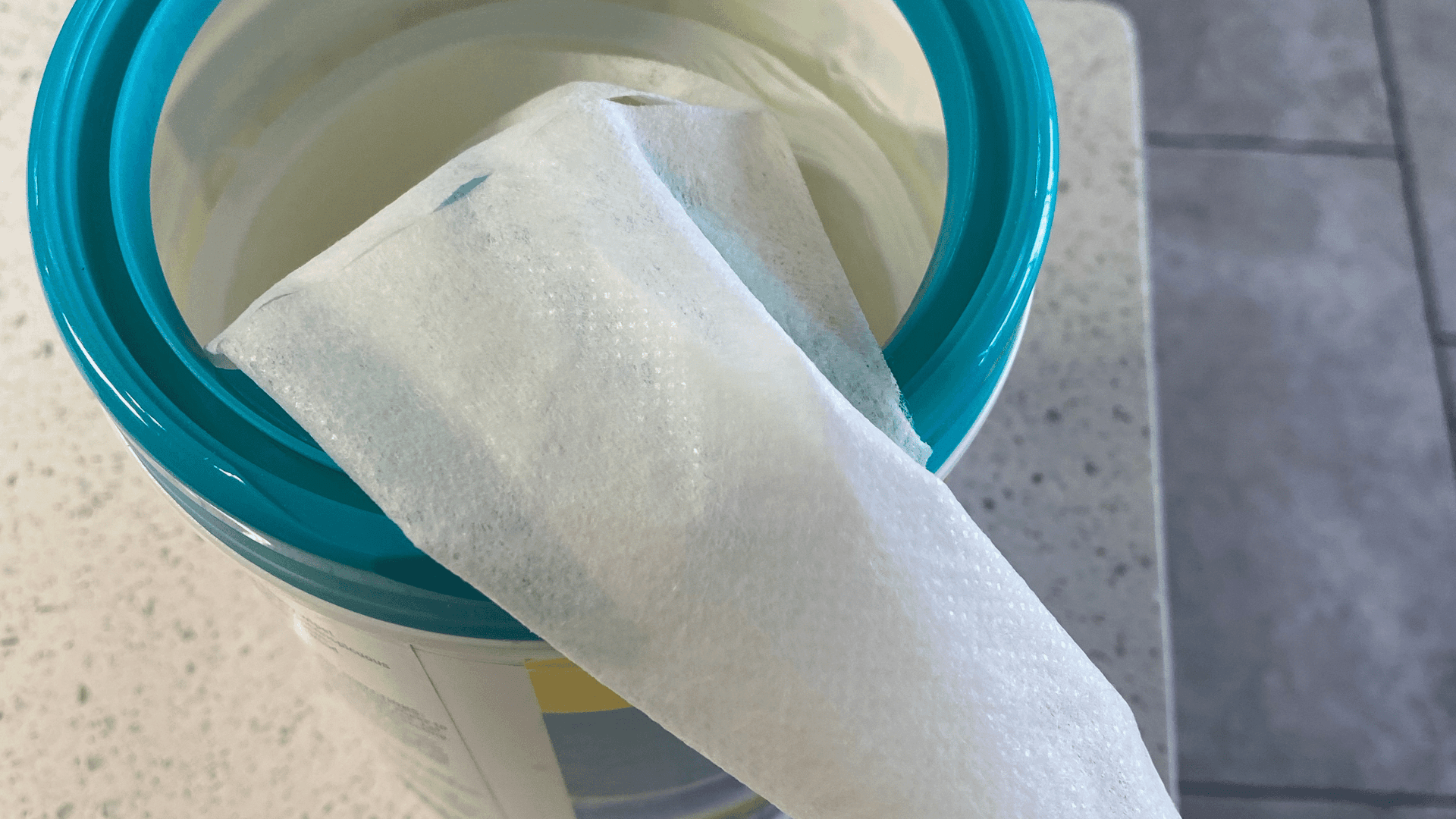
To meet contact time requirements in practice, you need a wipe that holds enough liquid. A dry wipe cannot deliver the correct dose. Wipe quality varies by material. Nonwoven polyester and polypropylene blends with a GSM (grams per square meter) of 50 to 70 hold more solution than thinner wipes. Some suppliers offer wipes with a high liquid to wipe ratio, around 2.5 to 3.0 fluid ounces per wipe. That extra moisture ensures the surface stays wet long enough. In a busy hotel or gym, this reduces the risk of incomplete disinfection. Your staff should be trained to use two wipes for larger surfaces.
Storage and Shelf Life
Disinfectant wipes have a shelf life. Most bulk containers are stamped with an expiration date 12 to 24 months from manufacture. After that date, the active ingredients degrade and the kill claims are no longer guaranteed. Store wipes in a cool dry area between 50°F and 80°F (10°C to 27°C). Temperatures above 90°F (32°C) can cause the solution to evaporate or separate. Freezing temperatures below 32°F (0°C) can damage the wipe material and reduce effectiveness.
Humidity also matters. Wipes stored in damp basements or near steam lines can grow mold in the canister. Always keep the lid tightly closed after each use. A canister left open for an hour in a gym locker room can lose 10% of its moisture content. That dry wipe will not deliver the required contact time. For high volume facilities like hotel housekeeping carts, consider using smaller refill packs rather than one giant tub. This keeps the unused wipes fresh longer.
Rotate your stock. Use the oldest wipes first. When you receive a new pallet of 500 units, place the new cases behind the old ones. Mark the shelf life on each case with a permanent marker. If you store wipes near your wholesale beach towels or wholesale hotel towels, make sure the linens are not exposed to any chemical leaks. Wipe solution can stain white towels permanently. Keep chemical products on separate shelving.
Disposal and Environmental Impact
Disinfectant wipes are not flushable despite what some labels say. The Federal Trade Commission (FTC) has taken action against companies that falsely market wipes as flushable. Wipes clog pipes, damage sewage pumps, and cause costly plumbing repairs. The only exception is wipes that pass the INDA/EDANA flushability guidelines, but even those are not recommended for commercial drains. Always dispose of used wipes in lined trash bins. Do not throw them in recycling. They are contaminated with chemicals and pathogens.
Some wipes contain plastic fibers that do not biodegrade. Look for wipes made from plant based fibers like viscose or lyocell. These biodegrade faster in landfills. The active ingredients also matter. Quaternary ammonium compounds can be toxic to aquatic life if they enter waterways. Hydrogen peroxide breaks down into water and oxygen, making it a greener choice for facilities near sensitive environments. Check the safety data sheet for each product.
Train your staff on proper disposal. Post signs near cleaning stations. In a restaurant, used wipes from food contact surfaces must go into a designated trash container, not the organic waste bin. In a spa, wipes used on treatment tables should be double bagged before disposal. Bulk buyers can negotiate with waste haulers for a lower rate if they can show their wipes are non hazardous. Most disinfectant wipes are not classified as hazardous waste, but local regulations vary. Check with your state environmental agency for specific rules.