
Commercial Restaurant Towels: Kitchen & Customer Solutions
Restaurant operations demand towels that can handle intensive kitchen work and enhance customer experience. The wrong towel choice costs money through frequent replacements, poor performance, and unhappy staff or guests.
Commercial restaurants need different towel types for kitchen work (100% cotton herringbone weave bar mops) versus customer service (spun polyester napkins), with bulk purchasing from wholesale suppliers offering the best cost efficiency for high-volume operations.
What are the best alternatives to paper towels in commercial kitchens?
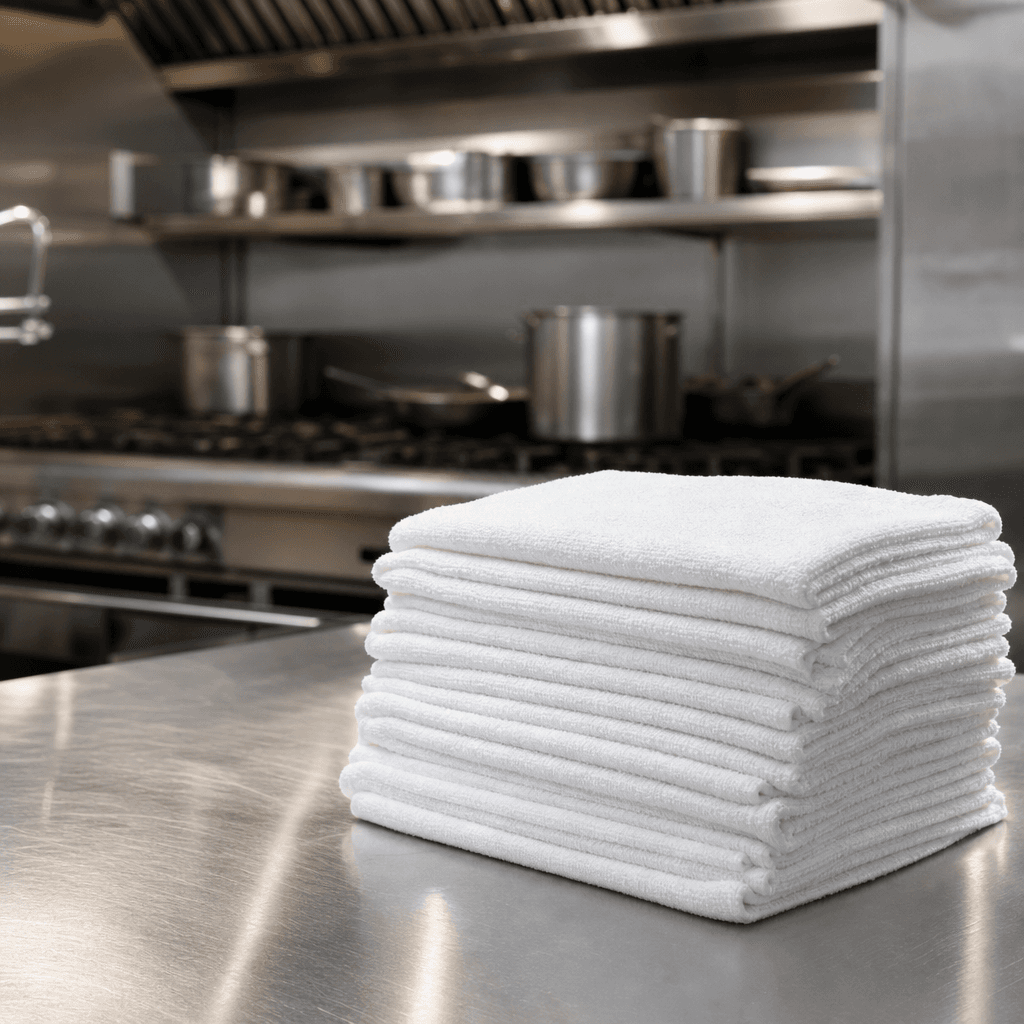
Cotton kitchen towels with herringbone weave construction offer the most practical alternative to disposable paper towels in restaurant kitchens. These towels, typically sized 15x26 or 16x27 inches and weighing 24 ounces, absorb spills better than paper while standing up to commercial washing cycles. The blue center stripe design helps kitchen staff quickly identify clean towels from a distance.
Bar mop towels represent the same product with different terminology. Many restaurant purchasers know them as bar towels, but the specifications remain identical. The 100% cotton construction handles hot surfaces, grease cleanup, and general kitchen tasks that would require multiple paper towels. A single cotton kitchen towel can replace 20-30 paper towels during a busy service shift.
The economics favor reusable towels once restaurants reach moderate volume. A case of 300 paper towel rolls costs approximately $180 and lasts one month in an average restaurant kitchen. The same operation can purchase 50 commercial-grade cotton towels for $200 that last 18-24 months with proper care. The math becomes more compelling as restaurant size increases, with larger operations seeing payback periods of 2-3 months.
Where can restaurants buy bulk kitchen towels cost-effectively?
Wholesale linen suppliers provide the most cost-effective channel for restaurants purchasing bulk towels. Companies specializing in commercial linen distribution offer volume pricing tiers that retail stores cannot match. Towel Depot's 59 years in wholesale distribution demonstrates the stability needed for consistent restaurant supply chains, serving over 10,000 commercial clients including restaurants, hotels, and food service operations.
Volume discounts create significant savings for restaurants buying in appropriate quantities. Standard pricing tiers offer 5% discounts starting at 5 units, 10% at 10 units, and 15% savings at 15 or more units. Restaurant buyers typically purchase 100-500 kitchen towels per order to maximize these discounts while maintaining adequate inventory rotation. Smaller restaurants can coordinate purchases with neighboring establishments to reach higher discount tiers.
Lead times matter for restaurant operations that cannot afford stockouts. Wholesale suppliers typically ship standard towel orders within 2-3 business days, compared to 1-2 weeks for custom or embroidered products. Restaurants should establish reorder points based on usage patterns and washing frequency to prevent kitchen disruptions. Most successful restaurant operators maintain 3-4 weeks of towel inventory to handle unexpected volume spikes or laundry equipment issues.
How do restaurant-grade kitchen towels compare to disposable paper towels?
Commercial-grade cotton towels absorb 3-4 times more liquid than equivalent amounts of paper towels, making them more effective for kitchen spill cleanup. The herringbone weave construction in restaurant towels creates superior absorption channels while maintaining structural integrity when wet. Paper towels disintegrate under stress, often leaving residue on surfaces that require additional cleaning.
Durability represents the most significant difference between commercial cotton towels and disposable alternatives. Restaurant-grade towels withstand 200+ commercial wash cycles before showing significant wear, while consumer-grade alternatives fail after 50-100 cycles. This durability translates to 2-3 years of service life in busy restaurant kitchens, compared to single-use disposal of paper towels. OSHA guidelines for restaurant sanitation emphasize the importance of using clean, dedicated towels for different kitchen tasks.
Heat resistance gives cotton towels advantages in professional kitchens. Cotton fibers handle hot cookware and equipment without melting or degrading, while paper towels can ignite or leave residue on hot surfaces. Kitchen staff can safely use cotton towels for tasks involving temperatures up to 400°F, expanding their utility beyond simple cleanup. The blue center stripe standard in commercial kitchen towels helps staff quickly identify these heat-safe options during busy service periods.
Why do some restaurants provide wet towels to customers at the table?
Customer wet towels serve both practical and hospitality functions in restaurant dining experiences. BBQ restaurants, seafood establishments, and ethnic dining concepts commonly provide wet towels because their food requires hands-on eating that leaves customers with messy fingers. The gesture signals attention to customer comfort while addressing a genuine practical need that paper napkins cannot adequately handle.
Cultural expectations drive wet towel service in many Asian, Middle Eastern, and Mediterranean restaurants. Customers from these backgrounds expect pre-meal hand cleaning as part of proper dining etiquette. Restaurant operators serving these markets include wet towel service to meet cultural standards and differentiate from competitors who may overlook this detail. The towels typically arrive heated or at room temperature, never cold, to enhance the comfort experience.
Operational considerations include towel type, preparation, and sanitation protocols. Most restaurants use small terry cloth towels, typically 8x8 or 10x10 inches, made from 100% cotton for better absorption. These towels require individual wrapping or serving in sanitized containers to meet health department standards. Staff must follow strict procedures for towel preparation, including proper water temperature, approved sanitizing solutions, and single-use protocols to prevent cross-contamination between customers.
What type of towels work best for customer hand cleaning at restaurants?
Spun polyester napkins provide the most practical solution for customer hand cleaning in restaurant settings. Standard 20x20 inch napkins offer adequate coverage for most dining situations, while banquet operations may prefer larger 21.5x41 inch formats for formal place settings. The 100% spun polyester construction resists staining and maintains appearance through multiple wash cycles better than cotton alternatives.
Absorbency matters more than fabric type for effective hand cleaning. Spun polyester fibers create microscopic spaces that trap moisture and oils from customer hands. The synthetic construction also resists bacterial growth better than natural fibers, important for food service sanitation. Cotton Momie napkins represent a premium option for upscale establishments, but most restaurant operations find spun polyester delivers better performance at lower cost.
Color selection affects both functionality and brand presentation. White napkins remain the standard choice for most restaurants because they demonstrate cleanliness and coordinate with any table setting design. Colored napkins can hide minor stains but may appear less sanitary to customers concerned about restaurant hygiene. Black napkins work well in upscale establishments where the dramatic presentation outweighs traditional cleanliness signals, similar to trends in salon and spa industries where wholesale bath towels in dark colors hide product stains.