
Bulk Kitchen Towels: A Wholesale Buyer's Guide for Commercial Use
Kitchen towels are one of the cheapest lines in a linen budget and one of the most frequently replaced. Buy the wrong ones and you restock every few months, with lint on glassware and stains that never lift. These are the five questions buyers ask us most, answered from 59 years of wholesale experience.
Buy 100% cotton herringbone kitchen towels at 24 oz in 15x26 or 16x27, order at tier volume, and launder them correctly, and they will outlast consumer towels many times over.
What GSM and weave should purchasing managers look for in bulk kitchen towels for high-turnover commercial use?
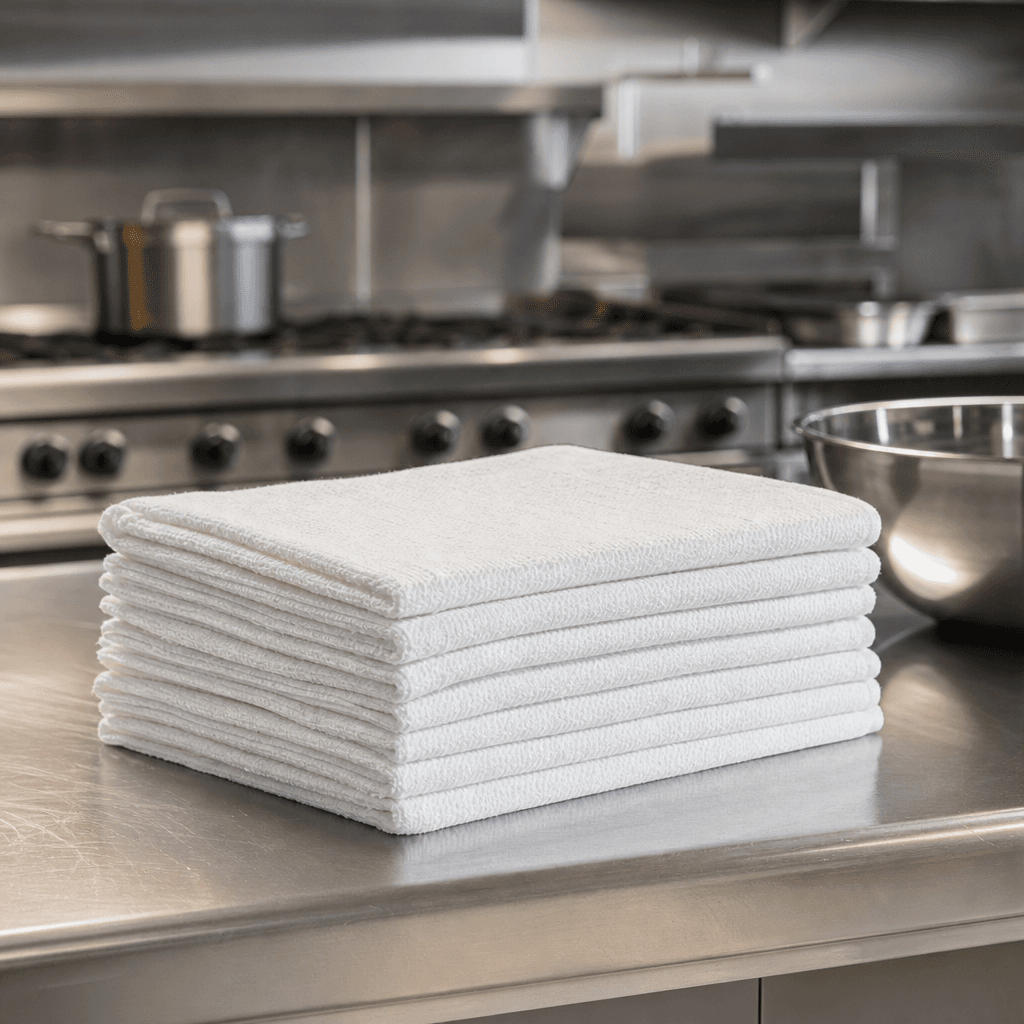
Our standard kitchen towel is 100% cotton, herringbone weave, with a blue center stripe, 24 oz, in 15x26 or 16x27. In the trade, that 24 oz figure is per dozen, and on a 15x26 towel it works out to roughly 225 GSM. Retail shoppers think in GSM. Mills and wholesalers think in ounces per dozen. Ask a supplier for both numbers and you will quickly spot vague listings. Some customers call this same product a bar mop. Same towel, different name.
Why 24 oz? Below about 18 oz per dozen, a towel dries fast but thins at the corners within a few months of daily use. Much heavier than 24 oz, and it takes longer to dry in the laundry, costs more to ship, and weighs down a commercial laundry bill that is often charged by the pound. At 24 oz, a line cook can wring it out, it still holds together after hundreds of cycles, and it folds small enough to fit a station pocket.
The weave matters as much as the weight. Herringbone is a diagonal twill pattern with a tighter structure than a loose plain weave, so it wipes plates and counters without shedding much lint. Some buyers ask about flour sack towels bulk, which are a thinner, flatter weave. They are good for polishing glassware and covering proofing dough, but they are a supplement, not a replacement for a work towel. For a bulk kitchen towels program that covers spills, hands, and surfaces, herringbone at 24 oz is the workhorse. You can compare sizes and packs in our kitchen towels collection.
How do waffle weave, terry, and flat weave kitchen towels compare for absorbency and lint control in salons, spas, and hotel kitchens?
Terry has the most absorbency per ounce because the loops hold water. It also sheds the most lint when new and snags on rough surfaces like steel prep tables and rings. That makes terry a good fit for salon stations and spa treatment rooms, where the job is drying hands, skin, or tools, and a poor fit for polishing glasses. If you need hand-sized terry, look at our wholesale hand towels rather than forcing a kitchen towel to do the job.
Waffle weave sits in the middle. The honeycomb pockets absorb well and dry faster than terry, so they suit humid spaces. The same pockets trap crumbs and soap residue, and lint is higher in the first several washes. Flat and twill weaves such as herringbone absorb a little less per ounce but release almost no lint and leave glass streak free. In a hotel kitchen, where a towel wipes a plate rim before it goes to a guest, lint control wins every time.
A question we hear often is terry cloth vs microfiber. Microfiber picks up dust well, but it does not handle chlorine bleach or high-heat sanitizing the way cotton does, and it holds odor after greasy use. Cotton can take hot water and bleach, which is why we sell cotton for food service. Color is a separate decision. White is the top choice for salons and hotels because you can bleach it and it shows cleanliness. Black is growing in salons because it hides hair dye. For pool decks and spa lounges, you want a different tool entirely, and our wholesale beach towels are sized for that.
What is a realistic per-towel cost range when buying kitchen towels wholesale, and how do case quantities and order volume change the price?
Price depends on cotton markets, so any number printed in a blog post ages quickly. In our experience, 24 oz cotton herringbone towels at commercial volume land in the low single dollars per towel, well above a bargain-bin retail towel and well below what you pay when you replace cheap ones four times a year. Buyers who search for towels in bulk often compare the sticker price alone. That is the wrong comparison. Compare cost per use instead.
Here is the math with an illustrative $2.00 towel built for 200+ wash cycles. That is one cent per use. A $1.00 consumer towel that fails at 50 to 100 cycles costs about one to two cents per use, and you also pay for the labor and the reorder. Our B2B customers typically place orders of 100 to 500+ units, and our pricing tiers are built for that volume. The discount is transparent: 5% at 5 units, 10% at 10 units, and 15% at 15 or more. On that illustrative $2.00 towel, 15 units brings the price to $1.70.
When you shop for bulk towels wholesale, ask whether the supplier is a manufacturer-direct company or a marketplace reseller. We are family-owned and have been in business since 1967, and we are not a dropshipper, so what is in the catalog is in the warehouse. Standard orders ship in 2 to 3 business days. Custom or embroidered orders take 7 to 10 days, so plan those into your par restock schedule before you run low.
How many wash cycles should a commercial-grade kitchen towel last, and which fabric and stitching details signal durability before you buy?
Commercial-grade means built for 200+ wash cycles. Consumer retail towels typically fail at 50 to 100. We see the same mistake constantly: a buyer picks up consumer-grade towels for a restaurant or salon, then replaces them every 3 to 6 months. A commercial-grade towel in the same job usually runs 2 to 3 years. Your cost per towel is higher on day one and much lower by month ten.
Check fabric first. You want 100% cotton, not a blend, because cotton holds up to bleach and hot water, and polyester blends repel water and spread grease rather than lifting it. Polyester has its place. Our table linens and napkins are 100% spun polyester, in sizes like 20x20, 22x22, and 21.5x41 banquet, because napkins need to resist wrinkles and stains. Kitchen towels have the opposite job. They need to absorb.
Then look at the hems. Pull on a hemmed edge with both hands. A good towel has a double-folded hem with tight, even lockstitching and no skipped stitches. A single fold with a loose chain stitch unravels after a few dozen cycles, and the unraveling runs the length of the edge. Hold the towel up to a window. Even weave density and no thin patches means the yarn was spun consistently. Finally, confirm the weight per dozen on the spec. If a listing only gives dimensions, ask for the ounce rating before you place the order.
What laundering practices keep bulk kitchen towels absorbent and stain-free, and how do they differ for in-house laundry versus a commercial laundry service?
In-house, the biggest mistake is fabric softener. It coats cotton fibers with a waxy film, and absorbency drops within a few washes. Skip it entirely. Wash kitchen towels separately from napkins and spa linens, because grease transfers. Use hot water, 140 to 160 degrees Fahrenheit where your machine allows, an alkaline detergent for grease, and chlorine bleach on white towels at the dilution your detergent maker specifies. Do not overload the washer. Towels need room to flex or soil stays in the weave. Dry on medium, not scorching, and pull them promptly so they do not sit wet and sour.
Stains need quick action. Tomato, coffee, and hair dye set when they dry. Rinse or soak stained towels the same shift. For salons using color, keep a dedicated black set for dye work and keep whites away from it. If a towel retires from the kitchen because of stains, it can move to cleaning duty. Rotating towels also spreads wear. We recommend three par levels, one in use, one in the laundry, and one on the shelf, so no towel gets washed twice a day.
With a commercial laundry service, you give up control of the chemistry but gain consistency, since their formulas and water temperatures are set for heavy soil. Ask three questions before signing: what bleach and sour cycle they run, how they count and report losses, and what their dryer temperature is. Services that over-dry shorten towel life. Whatever route you choose, food-safe handling matters too. The FDA Food Code sets rules for how wiping cloths are used and stored in food establishments, so check your local health department's version.
Frequently Asked Questions
- What GSM and weave should purchasing managers look for in bulk kitchen towels for high-turnover commercial use?
- Look for 100% cotton herringbone weave at 24 oz per dozen, which is roughly 225 GSM, in 15x26 or 16x27. That weight balances absorbency, drying time, and durability. Ask suppliers for ounces per dozen, not just dimensions.
- How do waffle weave, terry, and flat weave kitchen towels compare for absorbency and lint control in salons, spas, and hotel kitchens?
- Terry absorbs the most but sheds the most lint, waffle weave dries faster but traps debris, and flat or herringbone weave gives the best lint control. Salons and spas favor terry for skin and hands, while hotel kitchens favor herringbone for plates and glassware.
- What is a realistic per-towel cost range when buying kitchen towels wholesale, and how do case quantities and order volume change the price?
- Commercial 24 oz cotton herringbone towels typically cost low single dollars each at volume, and the cotton market moves that figure. Our tiers are 5% off at 5 units, 10% at 10, and 15% at 15 or more. Judge cost per use, not sticker price.
- How many wash cycles should a commercial-grade kitchen towel last, and which fabric and stitching details signal durability before you buy?
- Commercial-grade towels should last 200+ wash cycles, versus 50 to 100 for consumer retail. Look for 100% cotton, an even herringbone weave, and double-folded hems with tight lockstitching. Loose chain stitching and thin patches predict early failure.
- What laundering practices keep bulk kitchen towels absorbent and stain-free, and how do they differ for in-house laundry versus a commercial laundry service?
- In-house, use hot water, alkaline detergent, bleach on whites, no fabric softener, and no overloading. With a commercial service, ask about their bleach program, loss reporting, and dryer temperature, since over-drying shortens towel life.