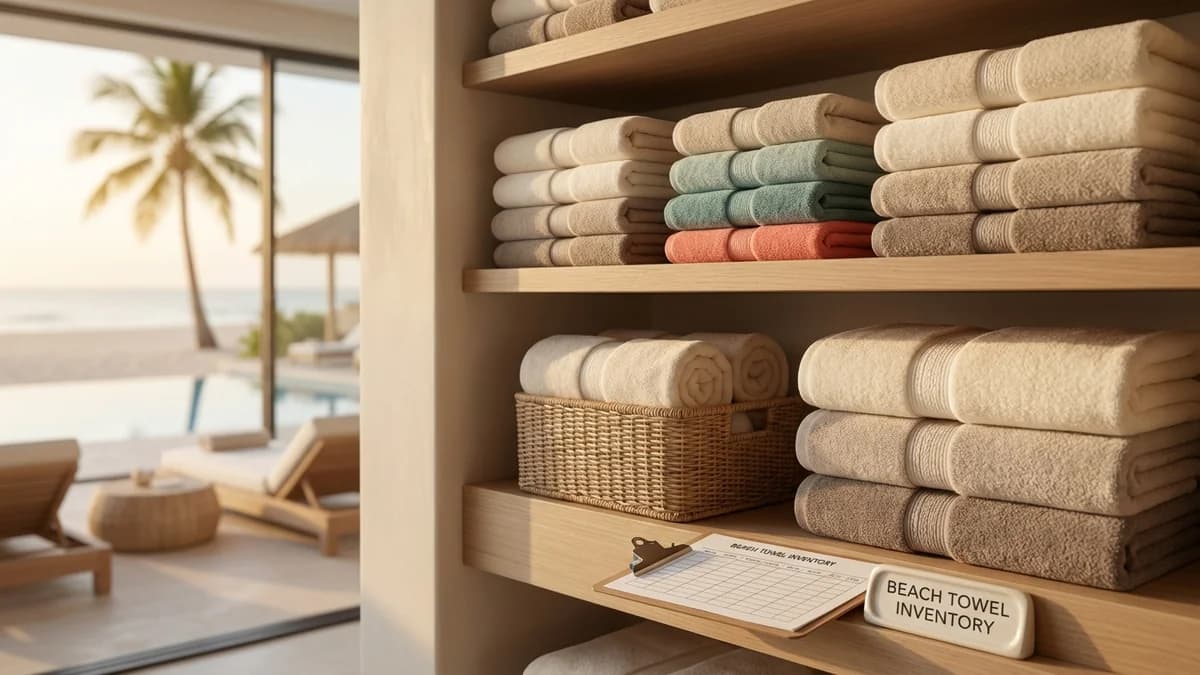

Beach Towel Inventory Management for Resorts
In this guide:
- How Many Beach Towels Should a Resort Stock Per Guest?
- What GSM Beach Towel Is Best for High Volume Resort Use?
- How to Extend the Life of Beach Towels in Your Inventory?
- What Are the Best Laundry Practices for Resort Beach Towels?
- How to Calculate the True Cost of Beach Towels for Your Resort?
- Frequently Asked Questions
Beach towel inventory management for resorts is a daily operational challenge. You need enough stock to cover peak occupancy without tying up capital in excess linens. This guide gives you the numbers and processes used by top hospitality buyers to control costs and maintain quality across hundreds of towels.
Stock 3 beach towels per guest for poolside use and 2 for beach use. Choose 500 GSM ringspun cotton towels. Expect to replace 20 percent of inventory each year. Use a towel deposit system to cut loss by up to 50 percent.
How Many Beach Towels Should a Resort Stock Per Guest?
The industry standard for full service resorts is three towels per guest for pool areas and two towels per guest for beach access. That gives you a total of five towels per registered guest. For a 200 room resort with an average occupancy of 1.8 guests per room, you need 1,800 towels just for pool and beach use. Add another 200 towels for spa and gym areas. That brings your base order to 2,000 towels. These numbers come from the American Hotel and Lodging Association guidelines.
Your inventory turnover rate should be 3 to 4 sets per guest per day during peak season. That means each towel gets used and laundered at least three times daily. If you operate a towel checkout program with pool passes, you can reduce the number of towels per guest to 4 total. But do not go below 3 towels per guest. Shortages create guest complaints and strain your laundry operation. Resorts that track this metric closely find that a 10 day supply in rotation is the sweet spot.
Seasonal resorts in Florida and California often double their inventory from May through September. A property with 150 rooms might hold 1,500 towels in low season and 3,000 towels from June to August. This keeps your linen investment aligned with revenue. You can store off season towels in climate controlled storage at 18 to 24 degrees Celsius (65 to 75 degrees Fahrenheit). Avoid direct sunlight and high humidity. Those conditions accelerate cotton degradation by as much as 30 percent. Check with your wholesale beach towels supplier about off season storage recommendations.
What GSM Beach Towel Is Best for High Volume Resort Use?
For a resort that washes towels 150 to 200 times per year, GSM is your most important specification. GSM stands for grams per square meter. It tells you the fabric weight and density. A 400 GSM towel feels thin and wears out fast after 80 to 100 washes. A 600 GSM towel is plush but takes 25 percent longer to dry in commercial dryers. That increases your energy costs. The best GSM for resort beach towels is 500. That weight delivers enough absorbency for guests while drying fast enough to keep your laundry cycle under 45 minutes per load.
Fabric construction matters as much as GSM. Ringspun cotton with a zero twist yarn creates a dense weave that holds up to repeated washing. Tests from ASTM standard D4772 show that 500 GSM ringspun towels lose only 3 percent of their weight after 50 wash cycles. In comparison, a 450 GSM open end towel loses 8 percent over the same period. That weight loss translates directly to reduced absorbency and a rough texture. Your guests will notice the difference after three months. Choose a towel with a double selvage edge. It prevents fraying and adds 20 to 30 extra wash cycles to the towel life.
Color selection also plays a role in towel longevity. Light colors such as white, beige, and light blue show stains less and hold up to bleach treatments. Dark colors like navy or forest green require lower wash temperatures and cannot tolerate chlorine bleach. That limits your ability to fully sanitize them. Most resorts choose a mid tone color like terracotta or seafoam that hides sunscreen stains but still allows high temperature washing. Aim for towels with a dye sublimation rating that meets Oeko Tex Standard 100. That certification ensures no harmful chemicals leach during washing. Many properties now order from hotel and hospitality linens suppliers that offer this guarantee.
How to Extend the Life of Beach Towels in Your Inventory?
The average beach towel in a resort lasts 150 to 200 wash cycles. You can push that to 250 cycles with proper care. The first step is pre treating stains before washing. Sunscreen, body oils, and tanning lotions are the main culprits. Spray a pre wash stain remover on the affected areas and let it sit for 10 minutes. An enzyme based detergent works best because it breaks down organic oils. Use 120 grams of detergent per 50 pound load. Do not overload the machines. A 50 pound commercial washer should hold no more than 40 towels. Overloading reduces wash effectiveness by 15 to 20 percent.
Water temperature is critical. Wash beach towels at 60 degrees Celsius (140 degrees Fahrenheit). That temperature kills bacteria and melts sunscreen residue. Once a month run a special cycle at 71 degrees Celsius (160 degrees Fahrenheit) with chlorine bleach. This strips the chemical buildup that makes towels stiff. But do not bleach every load. Over bleaching weakens cotton fibers by 12 percent after 10 cycles. For white towels, use sodium hypochlorite bleach with a concentration of 5.25 percent. For colored towels, use oxygen bleach or hydrogen peroxide. Rinse twice to remove all chemical residue. Leftover bleach causes rapid fiber breakdown.
Drying temperature matters just as much. Commercial dryers should operate at 80 degrees Celsius (176 degrees Fahrenheit). That is hot enough to dry a 500 GSM towel in 35 minutes. If you run the dryer at 90 degrees Celsius (194 degrees Fahrenheit), you cut drying time by 5 minutes but increase fiber damage by 20 percent. The rule is to tumble until the towel reaches 6 percent moisture content. Overdrying to 2 percent moisture makes the towel stiff and brittle. Install moisture sensors on your dryers to stop them automatically. This simple change can extend towel life by 30 wash cycles. For more on laundry best practices, check guidelines from the OSHA laundry safety standards.
What Are the Best Laundry Practices for Resort Beach Towels?
Sorting is the first step that many resorts skip. Separate beach towels by color and by soil level. Towels with heavy sunscreen stains need a heavy soil cycle. Towels with light use can run a normal cycle. Mixing them forces the heavy soil towels to wash longer than needed, which wastes water and detergent. A typical commercial washer uses 150 liters of water per cycle. Sorting can reduce water consumption by 10 to 15 percent. That adds up to significant savings. For a resort doing 100 loads per week, that equals 1,500 liters saved every week. Follow water conservation recommendations from the EPA WaterSense program to set targets.
Use a neutral pH detergent with a range of 6.5 to 7.5. Alkaline detergents above pH 8 can cause yellowing in white towels after 20 washes. Acidic detergents below pH 5 weaken cotton fibers. Check your detergent label and test the pH of the wash water monthly. Add a sour (an acid rinse agent) in the last cycle to neutralize any remaining alkali. This keeps the towel soft and extends its life. The rinse water temperature should be 40 degrees Celsius (104 degrees Fahrenheit). Cold rinses below 30 degrees Celsius (86 degrees Fahrenheit) leave detergent residue. That residue attracts dirt and makes towels gray after 50 washes.
Extraction speed in the washer affects drying time. A final extraction at 300 G force removes 10 percent more water than a 200 G force extraction. That translates to 8 minutes less drying time per load. Over an 8 hour shift, this saves 1 hour of dryer runtime. Multiply that by 365 days and you save significant energy. But do not exceed 400 G force. That can distort the towel weave and cause uneven shrinkage. The ideal shrinkage limit for a quality beach towel is 3 to 5 percent after 50 washes. Anything above 5 percent means the towel quality is poor. Your wholesale bath towels supplier should provide shrinkage data on every product spec sheet.
How to Calculate the True Cost of Beach Towels for Your Resort?
Your true cost per towel is not just the purchase price. It includes laundry costs, replacement costs, and loss from theft or damage. Start with the purchase price. A 500 GSM ringspun beach towel in white costs about $8 to $12 per unit when bought in bulk of 500 or more. Next factor in laundry cost per use. Industry data from the International Textile Rental Association shows that each wash cycle costs $0.30 to $0.50 for water, detergent, energy, and labor. Over 200 cycles, that adds up to $60 to $100 per towel. That is 6 to 10 times the purchase price. So linen cost is dominated by laundry, not the initial buy.
Theft and loss add another 15 to 25 percent to your cost. Resorts lose 1 out of every 4 beach towels annually. A towel deposit system can cut that loss by 35 to 50 percent. Charge a $10 deposit per towel at the pool desk. Return the deposit when the guest brings the towel back. This alone can save $2 to $3 per towel per year. Also track loss by month. If you see a spike in June, adjust your checkout system. Some resorts embed RFID tags into towels to monitor inventory. The tags cost $0.50 per towel but reduce loss by 75 percent. The ROI is typically 6 to 9 months.
Plan your replacement budget. With a 200 towel initial investment at $10 per towel, your upfront cost is $2,000. Add $60 in laundry cost per towel over its life, and the total ownership cost is $14,000. If you replace 20 percent of inventory each year, your annual renewal cost is $400 for towels plus $2,800 in launderable costs. That gives you a total annual linen cost of $3,200. By improving your laundry practices and reducing loss, you can cut that to $2,500. Compare these numbers to your current spend. Small changes in GSM choice and wash temperature yield real savings. For detailed cost analysis tools, refer to ASTM standard D5431 for textile cost of ownership.