
Bar Towels for Commercial Use: Expert Guide for Restaurant Buyers
In this guide:
- What GSM weight should I look for in commercial bar towels?
- How should I launder bar towels to maximize their lifespan?
- What is the best way to store bar towels to prevent odors?
- What fabric construction is most durable for high volume bar use?
- How many wash cycles should a quality commercial bar towel survive?
- Frequently asked questions
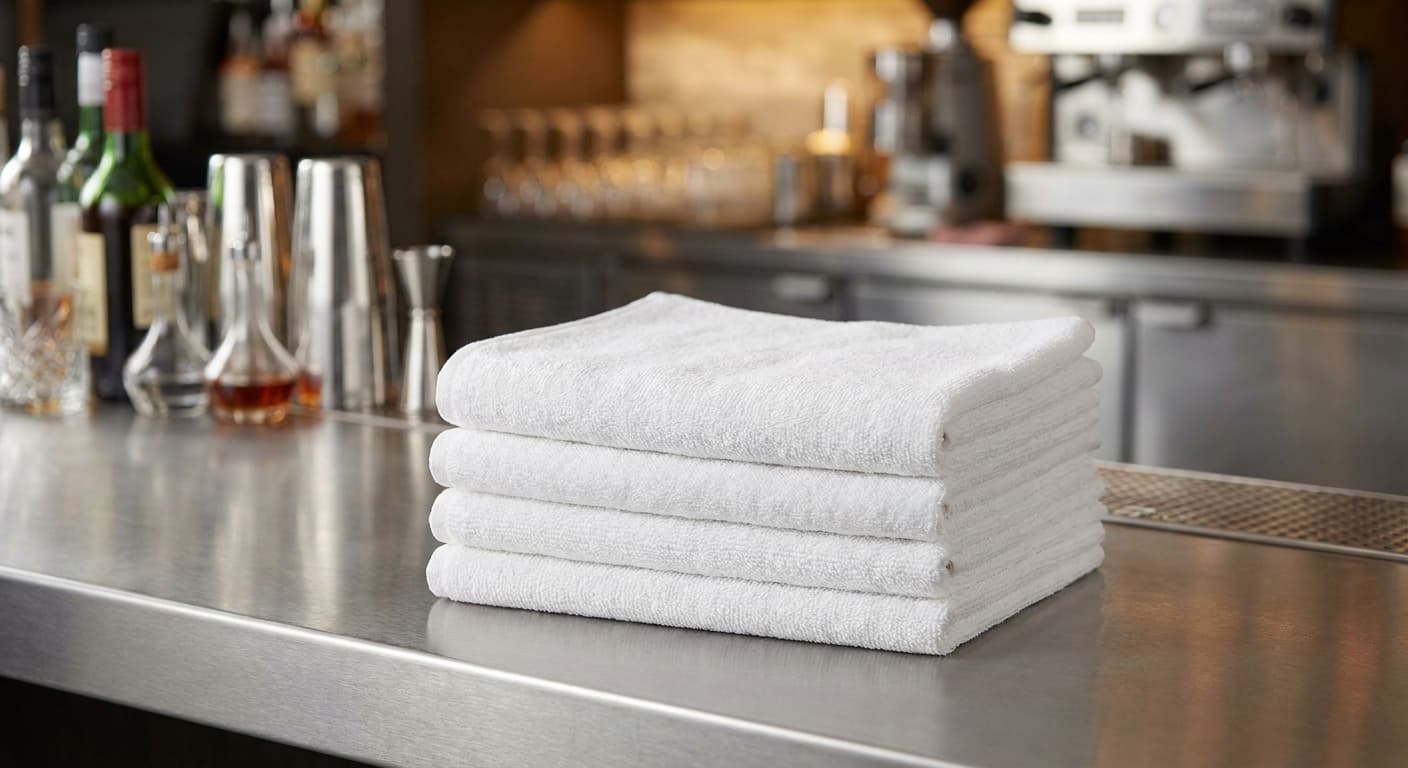
Bar towels are the most abused textile in any food and beverage operation. They wipe down sticky counters, polish glassware, and handle spills during twelve hour shifts. For B2B buyers placing bulk orders of 100 to 500 units, choosing the right bar towel directly affects your bottom line through replacement costs and staff satisfaction.
A quality 100 percent cotton bar towel with GSM between 350 and 450 will survive 200 plus wash cycles when washed at 160°F (71°C) and stored in ventilated bins. Skip polyester blends and fabric softener.
What GSM weight should I look for in commercial bar towels?
GSM stands for grams per square meter. It measures fabric density and directly affects absorbency and drying speed. For commercial bar towels, the sweet spot is 350 to 450 GSM. Towels below 350 GSM absorb too slowly and tear easily. Those above 450 GSM take forever to dry between uses and become heavy when wet. Your staff will complain about both extremes.
At 400 GSM, a standard 16 by 25 inch bar towel weighs about 190 grams. That weight gives you enough cotton fiber to soak up a full pint of spilled beer without dripping. Lighter towels at 300 GSM will leave wet streaks on your bar top. Heavier towels at 500 GSM may feel luxurious but they stay damp for hours, inviting bacterial growth and that sour smell every restaurant manager hates.
Our experience with restaurants across the country shows that 400 GSM bar towels hit the performance mark for 90 percent of high volume operations. The extra 50 grams of fiber per square meter compared to a 350 GSM towel gives you about 30 percent more absorbency. That translates to fewer towels needed per shift and lower laundry costs.
How should I launder bar towels to maximize their lifespan?
Heat is your best friend in commercial laundry. Wash bar towels at 160°F (71°C) minimum. This temperature kills bacteria and breaks down grease and food soils that cause odors and stiff fabric. Many restaurant operators run their washers at 120°F (49°C) to save energy. That saves pennies upfront but costs dollars in early towel replacement. Bacteria survive at 120°F (49°C) and multiply in the damp towel bin before your next shift.
Use a heavy duty detergent with a neutral pH between 7.0 and 8.0. Acidic detergents break down cotton fibers over time. Alkaline detergents leave a residue that attracts dirt. Add one cup of white vinegar to the rinse cycle once per week. The vinegar dissolves mineral buildup from hard water and neutralizes soap residue that traps odor causing bacteria. This simple step alone can double the usable life of your bar towels.
Never use fabric softener on bar towels. Fabric softener coats cotton fibers with a waxy layer that reduces absorbency by up to 40 percent. A towel that used to soak up a full spill will start to just push liquid around. Drying on high heat for 45 minutes at 180°F (82°C) completes the sanitization cycle. For more on linens that see similar heavy use, check out our guide to wholesale hotel towels which follow the same wash protocol.
What is the best way to store bar towels to prevent odors?
Moisture and lack of airflow cause the musty smell that plagues every commercial kitchen. Bacteria and mold need three things to grow: warmth, moisture, and food. Your bar towels provide all three after a shift. The solution is simple ventilation. Store used towels in plastic bins with perforated bottoms and sides. The holes let air circulate and allow moisture to drain away instead of pooling at the bottom of a solid bin.
Install wall mounted hooks or a drying rack in your back room. Between uses, hang towels flat or drape them over a bar. Never pile damp towels in a laundry hamper. In a high volume bar, you will see towels stay in that pile for four to six hours before the next wash. In that time, bacterial counts can increase 1000 percent. A ventilated storage system keeps the towel surface dry enough to slow growth significantly.
Keep your storage area below 70°F (21°C) and humidity below 50 percent. These conditions match guidelines from the CDC for controlling mold in commercial environments. If you notice odor even with proper storage, test your water temperature. Many operators find their water heater thermostat drifted down to 130°F (54°C) over time. Raise it back to 160°F (71°C) and the problem usually disappears within two wash cycles.
What fabric construction is most durable for high volume bar use?
One hundred percent ring spun cotton with a twill weave is the industry standard for a reason. Ring spun cotton fibers are twisted during spinning, which makes them stronger and more absorbent than open end cotton. Twill weave has a diagonal pattern that resists fraying and snagging better than plain weave. A well made twill bar towel will survive 300 wash cycles in a commercial washer without developing holes or thinning spots.
Huck weave is another option. It has a textured surface that offers good absorbency and resists pilling. Huck towels dry slightly faster than twill because the weave leaves more air space between fibers. The tradeoff is that huck weave frays at the edges faster than twill. If your staff tends to pull towels from tight storage slots, twill will hold up better over time.
Avoid polyester cotton blends for glass drying. Polyester fibers do not absorb water. They just push it around and leave streaks. Polyester also melts at high drying temperatures, causing rough spots that scratch glassware. Stick with 100 percent cotton for bar towels that will see heavy use. For towels used in lower contact applications like poolside, our wholesale beach towels offer a wider GSM range suitable for guest amenities.
How many wash cycles should a quality commercial bar towel survive?
A properly constructed 100 percent cotton bar towel should last 200 to 300 commercial wash cycles. That equals six months to one year in a busy restaurant doing five loads per week. Towels that start showing holes, thinning, or frayed edges before 150 washes are either poor quality or being washed incorrectly. Check your wash temperature and detergent first before blaming the towel manufacturer.
Fabric weight directly correlates with cycle life. A 350 GSM towel might survive 200 washes. A 450 GSM towel can hit 300 plus. But heavier towels also cost more and take longer to dry. The best investment for most operations is a 400 GSM towel. You get about 250 wash cycles for a reasonable upfront cost. Calculate your cost per use by dividing the towel price by the expected wash cycles. A 400 GSM towel at $1.50 gives you a cost per use of about half a cent. That is a good target.
If you wash towels at 160°F (71°C) and follow proper drying protocols, your bar towels will not shrink more than 5 percent over their life. Most of that shrinkage happens in the first ten washes. Buy towels cut slightly oversized to account for this. A 16 by 25 inch towel will shrink to about 15.5 by 24.5 inches. That is still a functional size. For towels used in guest bathrooms where shrinkage matters more, our wholesale bath towels are pre shrunk to minimize size loss.