
Air Drying vs Machine: Eco-Friendly Laundry Tips
In this guide:
- Does air drying really save enough energy to matter for a commercial operation?
- How much does machine drying shorten the lifespan of towels and linens?
- What is the most efficient way to air dry bulk linens in a business setting?
- Can I mix air drying and machine drying in the same laundry cycle?
- What are the actual dollar savings per load when switching from machine to air drying?
- Frequently asked questions
For hotel housekeeping managers, spa operators, and restaurant buyers placing bulk linen orders, the choice between air drying and machine drying goes far beyond personal preference. It affects your energy bills, your linen replacement costs, and your environmental footprint. This guide gives you the numbers and the practical steps to make the right call for your business.
Air drying cuts energy costs by 100 percent and can extend towel life by 30 to 50 percent. For commercial buyers, the hybrid approach of a short machine fluff followed by line drying delivers the best balance of speed, softness, and savings.
Does air drying really save enough energy to matter for a commercial operation?
Yes, the energy numbers are clear. A typical commercial gas powered dryer uses between 3 and 6 kilowatt hours per cycle, depending on load size and drying time. Electric dryers run even higher, often 5 to 8 kWh per cycle. For a mid sized hotel running 20 loads per day, that is 60 to 120 kWh daily just for drying. Over a year, the total easily exceeds 20,000 kWh. Air drying eliminates that entire draw. You pay nothing for the sun and the breeze.
The U.S. Environmental Protection Agency estimates that commercial laundry accounts for 30 to 40 percent of a hotel's total energy use in many climates. Swapping even half your drying cycles to air can drop that share noticeably. Workers exposed to extreme heat from dryers also face fatigue and dehydration risks, a factor the Occupational Safety and Health Administration (OSHA) highlights in its laundry guidelines. Reducing dryer run time lowers those risks directly.
Consider a spa that processes 200 towels daily. At 4 kWh per load and 5 loads a day, that is 20 kWh daily, or 7,300 kWh per year. At the national average industrial electricity rate of 0.12 per kWh, that equals 876 dollars annually. Air drying those loads saves nearly 900 dollars every year. For a chain of five locations, the savings jump to 4,380 dollars annually. That money goes straight to your bottom line. Learn more about commercial drying energy use at the ENERGY STAR commercial dryers page.
How much does machine drying shorten the lifespan of towels and linens?
Machine drying at high heat, typically 150 F to 170 F (65 C to 77 C), accelerates fiber breakdown in cotton towels. A 600 GSM ring spun towel designed for 400 commercial wash cycles may begin fraying and thinning after 250 cycles when dried in a machine. Air drying keeps the fabric at ambient temperature, usually 60 F to 85 F (15 C to 29 C) indoors, which preserves fiber integrity. The result: towels air dried from new can last 400 to 500 cycles before replacement.
The heat also damages elastic fibers in terry loops and causes shrinkage of 5 to 8 percent over the first ten washes. Air dried towels shrink only 2 to 4 percent total. That difference matters when you order matched sets for hotel suites or spa cabanas. If you are buying wholesale bath towels in bulk, a 5 percent shrinkage differential per towel adds up across 500 units.
Lint loss is another cost. Machine drying strips 0.5 to 1.5 grams of fiber per towel per cycle from the surface of 500 GSM terry. Over 300 cycles, each towel loses 150 to 450 grams of material, reducing GSM by 25 to 30 percent. The towel becomes thin, rough, and less absorbent. Air drying reduces lint loss to near zero. Your towels stay plush and functional longer, pushing replacement intervals from 18 months to 30 months in high turnover settings like a gym. Check the ASTM D2261 standard for fabric strength testing at ASTM to see how heat cycles affect tear strength.
What is the most efficient way to air dry bulk linens in a business setting?
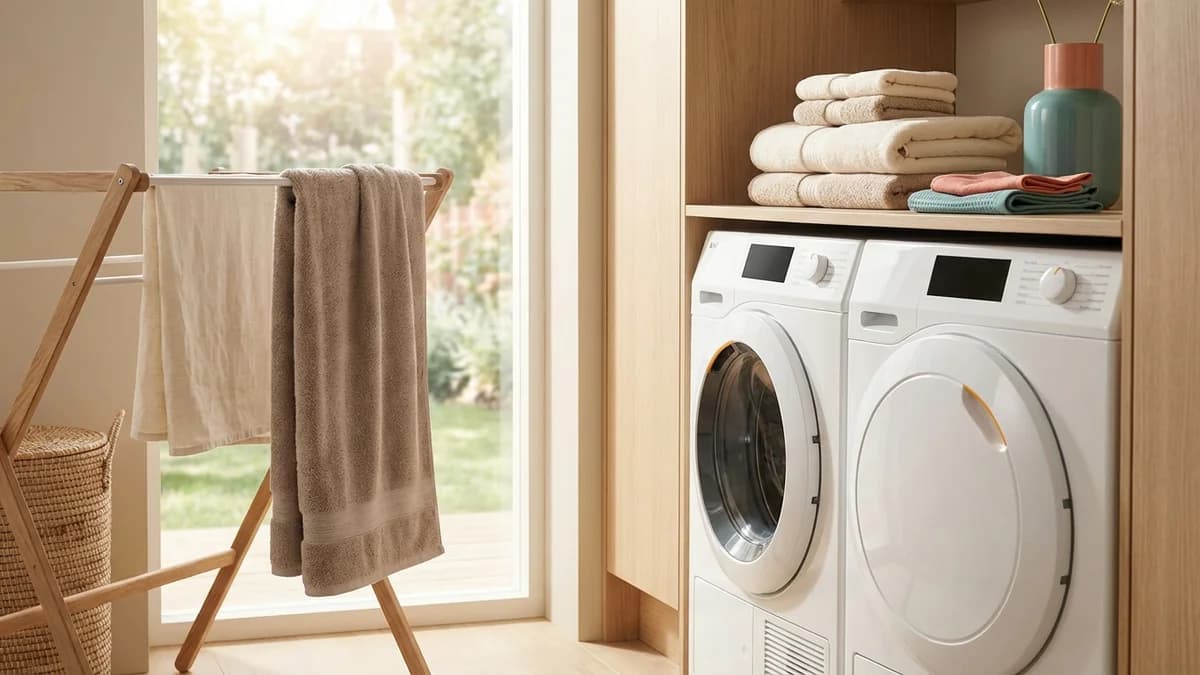
Commercial air drying requires space and airflow. The most efficient setup uses industrial rolling racks with double or triple bars. Fold each towel over the bar so air circulates on both sides. Leave 2 inches of space between towels. Place racks in a room with cross ventilation, ideally with floor fans running at medium speed. Average drying time for 500 GSM towels is 4 to 6 hours at 70 F (21 C) and 50 percent humidity. At 80 F (27 C) and lower humidity, it drops to 3 to 4 hours.
For high volume operations, rotate your stock. Dry half your towels on Monday rack and half on Tuesday. That way you always have dry towels ready without delaying turnover. Do not hang wet towels by the corners, that distorts the shape and creates uneven drying. Instead fold them in half lengthwise and drape over the bar. Use a dehumidifier in damp climates to keep drying time under 8 hours, which prevents mildew odors.
When buying new linens, consider GSM grade. Heavier towels, 700 GSM and up, take longer to air dry and may require 8 to 10 hours. Lighter 400 to 500 GSM towels dry faster and are ideal for restaurants and gyms where quick turnover is key. If you run a large hotel, consider installing dedicated drying rooms with heated floors (set to 85 F, 29 C) and exhaust fans. This speeds air drying to 2 to 3 hours for standard 500 GSM wholesale hotel towels. The room pays for itself in energy savings within two years.
Can I mix air drying and machine drying in the same laundry cycle?
Yes, this hybrid approach works well for commercial laundry. Run the machine dryer for 10 to 15 minutes at low heat, around 120 F (49 C). This fluffs the towels and removes loose lint and water droplets. Then take the towels out while they are still about 40 percent moist. Hang them on racks to finish drying. The short machine cycle uses only 0.5 to 1 kWh, cutting energy use by 80 percent compared to a full 45 minute dry cycle.
The hybrid method reduces wrinkling and keeps towels softer. Towels dried fully in a machine often come out stiff and harsh, especially if dried at high heat. The short low heat fluff opens the fibers, and the air drying finishes the process naturally. This is especially useful for high end spas where towel hand feel is critical. Your guests notice the difference between a crisp, brittle towel and a plush, air finished one.
Beach resort and pool towel operations also benefit from this method. Sand and salt residue can damage machine dryers. A short hot air fluff (140 F, 60 C for 8 minutes) followed by line drying removes moisture without baking the salt into the fibers. This extends the life of your wholesale beach towels. The Environmental Protection Agency's Safer Choice program offers guidelines on detergents and drying practices that reduce microfiber pollution, which is especially relevant when you air dry outdoors. Read their recommendations at EPA Safer Choice.
What are the actual dollar savings per load when switching from machine to air drying?
Let us break it down with real numbers. A commercial electric dryer rated at 7 kW running for 45 minutes uses 5.25 kWh per load. At the U.S. national average commercial rate of 0.12 per kWh, that load costs 0.63 cents. A gas dryer uses about 0.35 therms per load at 0.90 per therm, costing 0.32 cents per load. Air drying costs zero energy dollars. If you run 15 loads per day, 6 days a week, that is 90 loads weekly. Electric drying costs 56.70 per week, gas drying costs 28.80 per week.
Over 52 weeks, the electric dryer costs 2,948 annually. The gas dryer costs 1,498 annually. Air drying saves that entire amount. Add in reduced lint clean out costs, fewer dryer repairs, and lower replacement of heating elements and belts, and the savings climb higher. The only investment is drying racks. A heavy duty commercial rack costs 200 to 400 dollars and lasts 5 to 10 years. The payback period is less than three months for electric dryers.
Labor is the one variable. Hanging towels takes staff time. A worker can hang about 40 towels per minute once trained. For 90 loads of 25 towels each, that is 2,250 towels requiring about 56 minutes of labor per day. At 15 per hour, that is 14 dollars in additional daily labor, or 4,368 per year. Even after subtracting that labor cost, air drying still saves you about 1,580 per year versus electric drying. For a property with 200 rooms running three shifts, the math scales up. The real savings come from the extended linen life, which often dwarfs the energy savings. Track your own numbers with a simple spreadsheet. You will see the bottom line shift. For more on commercial laundry cost modeling, visit the ISSA industry association resources.